A Mountain to the North, a Lake to the South, Paths to the West, a River to the East by László Krasznahorkai belongs to the branch of literature that’s more “do unusual things with words” than “tell a story.” I picked it up on a recent trip to Frankfurt because Krasznahorkai won the 2025 Nobel Prize for Literature, and the book itself is short at 130 pages. If nothing else, I figured it might be a good introduction to his work.
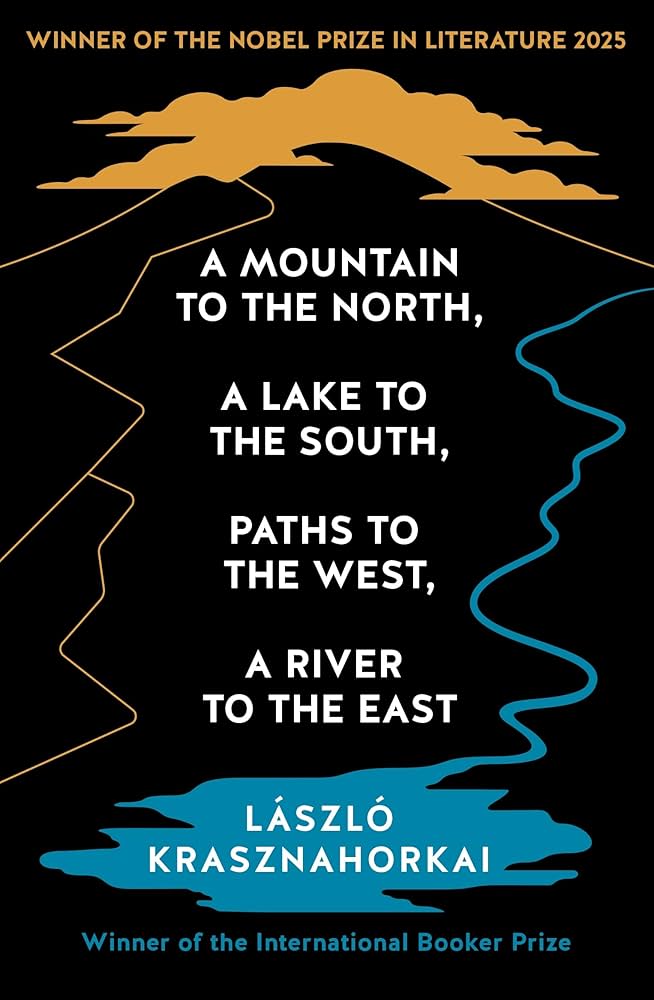
The lengthy title comes from the proper orientation of a Buddhist monastery, where most of the book takes place. It is not far from Kyoto, but getting there is not easy, and the book’s unattributed epigraph might also serve as a warning to the characters, if they could but read it: “None saw it twice.” Krasznahorkai relates his observations in 49 chapters numbered in Roman numerals beginning with II and ending with L. Presumably, beginning with the chapter two is meant to imply that readers are joining an ongoing tale, the beginning of which will remain unknown to readers and characters alike.
The chapters are short, but the sentences are long. Numerous chapters are one extended sentence Chapter XXVII, to pick one more or less at random, stretches its sentence across three full pages. They’re run-ons, of course. Mann and Proust delighted in clauses and conjunctions; sometimes when reading them I had the impression that finding out how many grammatical balls they could juggle was at least half the fun of writing that particular bit. Krasznahorkai does a fair amount of that, but he also charges straight through where even an extended sentence would normally end and just keeps going. (Although I lived in Budapest for a year and a bit, I never studied Hungarian systematically, so I certainly couldn’t say whether Krasznahorkai’s style in this book is as much of a stumbling block in the original as I found it in English. I suspect that it is; certainly Miklos Bánffy, the only other Hungarian writer I’ve read much of this century, does not take a similar approach.)
I think that Krasznahorkai chose the combination to suggest the shorter forms of Japanese poetry, or maybe visual arts in which a single image stands for larger stories, and a collection of images tells more than any individual item. A Mountain to the North… does not have a linear narrative, but the accumulation of chapters leads to an overall impression of the monastery and some of the events that took place there. I also think that Krasznahorkai was aiming to achieve something of a timeless effect, or rather to point toward the ways in which time is unreliable in and around the monastery.
For example, the one visitor who finds the monastery is the grandson of Prince Genji, which would mean he is from around the year 1000, but he arrives by train, alighting on a platform that features modern vending machines. In later chapters, Krasznahorkai shows some of his retainers who are searching for him. Their role seems feudal, but they are dressed in modern business suits, and they too arrive by train. Krasznahorkai devotes several chapters to the process of building the monastery, which proceeds according to a ritual that is apparently well known, but it happens over such a long span of time that I had a hard time seeing how any monastic order could have acquired enough practice to evolve rituals and standard procedures. There is a need for a monastery, and a site has been selected, but before building can begin monks must find a mountain where trees that can provide suitable wood for the monastery grow. Then they must buy the mountain, and wait for the right trees to grow. Then the trees must be harvested and brought to the site for the monastery, but the wood must also be aged in water. Then, and only then, many decades later can construction even begin. It’s a meditation on time, and timelessness, and the speed of natural processes, but I also balked a bit at monks who seemed to live for generations, if not centuries.
The other major feature of the world and monastery that Krasznahorkai depicts is that it has plenty of construction but almost no people. The station where Genji’s grandson leaves the train has an attendant, but no other passengers board or alight. The streets he passes through are empty; he has a brief conversation with one older woman. When he finally reaches the monastery, it too is deserted. In some buildings, people seem to have been gone for a long time; in others, as if they had just left. Again, the atmosphere is one of meditation. If A Mountain to the North… reminded me of anything in particular, it was of the early stages of the 1990s computer game Myst. There is a large and mostly empty world to explore, and it is all very atmospheric.
Of course a reader cannot explore but has to follow where Krasznahorkai leads. That is through the town and into the monastery, through the monastery and into both the abbott’s surprisingly disordered private quarters and past a secret garden that was, supposedly, the goal for Genji’s grandson. Alongside this throughline are meditations on the proper siting (with a mountain to the north, etc.) and construction of a monastery, the improbability of any individual spore becoming a tree, the bumbling efforts of the grandson’s retainers to find him, and similar things. The work captures moods and feelings, and, as it does not aim to tell a story, it does unusual and occasionally interesting things with words and sentences.
+++
Coda, four days later: Today at a bookstore I saw copies of Herscht 07769 and Baron Wenckheim’s Homecoming, and they both appeared to continue the style of single sentences that run across multiple pages. I think that’s fair warning that Krasznahorkai’s other works are not for me.

 Al Singh
 Doug Merrill
 Doreen Sheridan
 Emily Lauer
 John Pitzel
 Lars N. Goldschlager
 Laura Eilers
 Professor X
 Robert Maedgen
 Sylvere Ap Leanan
 The Shire
1 comment
thanks for sharing this topic