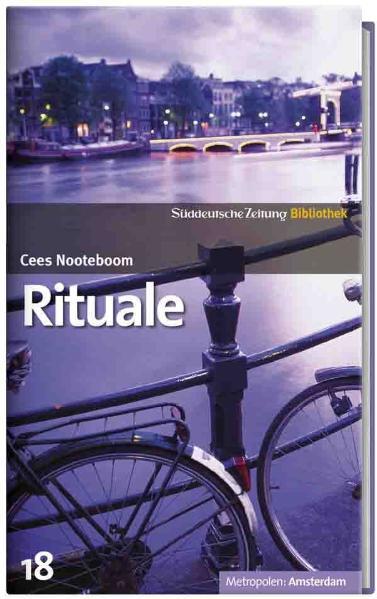
In Rituale — Rituals to give the book its English title — Cees Nooteboom begins in the middle, goes back to the beginning, and then skips a bit to get to something of an ending. As middle beginnings that might well be endings go, the first sentence in Rituals is arresting: “On the day that Inni Wintrop committed suicide, the stock for Philips was at 149.60.” (p. 9) The rest of the first paragraph goes on to muse that “memory is like a dog that lays down wherever it wants,” that if Inni was going to remember anything at all, it was that “the moon shone on the nearby canal, and that he had hanged himself in his bathroom” because of what he had written in the horoscope for Leos in the newspaper Het Parool, that their wife would run off with someone and that they would then kill themselves.
Nooteboom then moves back from that fateful day in 1963 to show some of how Inni and Zita came to know each other, came to be married. Inni has enough money that he makes his living partly by investing in the financial markets and partly as an art middleman, selling works onward to the people who actually sell to collectors. He and Zita had built a bit of a life together, she pursuing her interests and he keeping life interesting enough while also pursuing plenty of casual affairs. Inni had cried the first time they made love, but their life together was not enough to change his fundamental distance from nearly everything.
Years had passed since the night that Inni had cried on the steps of the Palace of Justice. Zita and Inni had eaten and drunk and had traveled. Inni had lost money in nickel and made money form watercolors of The Hague school. He had written horoscopes and recipes for Elegance. Zita had almost had a child, but this time Inni could not repress his fear of change and ordered the entrance to the world, which in the end did not interest him either, to be closed. With that action he had sealed the greatest change of all; namely, that Zita would leave him. Inni only noticed the first shadows: her skin dried out, sometimes her eyes looked past him, and she said his name less often. But he only associated these signs with her fate, not with his. (p. 11)
This introduction makes Rituals seem a sadder book than it is. It’s both funnier and stranger, as the next two sections reveal. The first, “Intermezzo,” ends with Inni realizing his suicide attempt has failed, and the reader realizing that the day in question was the day of Kennedy’s assassination.
Nooteboom then jumps back to 1953, the year that Inni turned 20, came into a substantial inheritance, and when his aunt Thérèse introduced him to her former husband, Arnold Taads. Thérèse is a woman of a certain age, given to enthusiasms and excessive drama, but essentially the only family member well disposed toward Inni, whose parents caused considerable scandal before excising him from their lives during his school years, his father by dying and his mother by remarrying and moving to Brazil. Taads in nearly her opposite, and Nooteboom does not try to make their former relationship plausible; it’s one of those things that seems more real for being unexplained. In the years since their separation, Taads has come to live alone except for his dog Athos, and he has regimented his life so strictly that when Thérèse and Inni arrive ten minutes early, he sends them away to walk in the park until the hour of their appointment should arrive.
Taads leads a regimented, ritualized life, that nevertheless cannot keep the peculiarities of the world at bay. Even at his young age, Inni is both appalled and fascinated; he keeps returning. Taads does teach him enough about money management that he can leave his dead-end job, and later live from what investing and art bring in. Inni seduces, or is seduced by, Taads’ housekeeper, who tartly informs him that her fiancé will be returning in two weeks, but he will do for now. The section ends with an unhinged dinner featuring Inni, Taads in a mood to provoke everyone nearby, high-strung aunt Thérèse, an uncle who gets steadily drunker as the evening progresses, and a prelate friend of Thérèse who winds up in the middle of everything. The ritual of a convivial meal descends into a farce of platitudes, attitudes and drunkenness, with Inni and the housekeeper left to pick up the pieces.
The third section skips forward twenty years to an Amsterdam of the early 1970s. Zita has never returned, which is what Inni expected. He has developed his own rituals. They keep life interesting enough but also keep him mostly detached from the people around him. One evening an improbable coincidence leads him to make the acquaintance of a certain Philip Taads, the son that Arnold Taads had never mentioned. The father ran out on the family when the son was very young; he has grown up with his Indonesian mother but is now old enough to lead his own life. (Arnold has died in the meantime. His ritual of spending deep winter alone in an isolated Swiss valley meant that there was no one to come to his aid when he needed it.) Without having known his father, Philip has, if anything, gone further in ritualizing his life. He works an office job just enough to cover his bare expenses. His true passion is an eclectic form of Zen that he has cobbled together from readings and study with a master he met through a yoga practice. Inni encounters him outside a specialist in Asian art, and they strike up a conversation about a cup in the display window. Philip is obsessed with the tea ceremony, and thus also with some of the great ceramicists of past centuries.
Though the book is part of the Süddeutsche Zeitung‘s Metropolen series, representing Amsterdam, the city is only really present in the third section. Inni visits various neighborhoods — his colleagues’ shops in the art world, the sketchy one where Philip has his Zen minimalist abode, the garret where a brief erotic interlude takes him (she, too, has a boyfriend), his own orderly quarter — allowing Nooteboom to portray the city as it was in the 1970s. Writing at the decade’s end — Rituals was first published in 1980 — he spares an aside for the era:
Inni sighed silently. The seventies. They had hardly slammed the church door behind them before they went crawling like beggars to be at the feet of some guru or swami. They were finally alone in a beautiful, empty universe that rattled along its own tracks like a train without a locomotive driver, and people were shouting of every window for help. (p. 141)
The book is carefully observed, and the people in it are engaging, even if nearly all of them are crazy in certain ways. Perhaps that makes it a realist work of fiction. The art dealers mostly find a way to get along in the uncaring universe. The most ritualized may have been the most sensitive, and they have a far more difficult time. Inni himself, who started the book trying to commit suicide almost on a whim, ends it with more equanimity than detachment, glad to still be in the world.

 Al Singh
 Doug Merrill
 Doreen Sheridan
 Emily Lauer
 John Pitzel
 Lars N. Goldschlager
 Laura Eilers
 Professor X
 Robert Maedgen
 Sylvere Ap Leanan
 The Shire