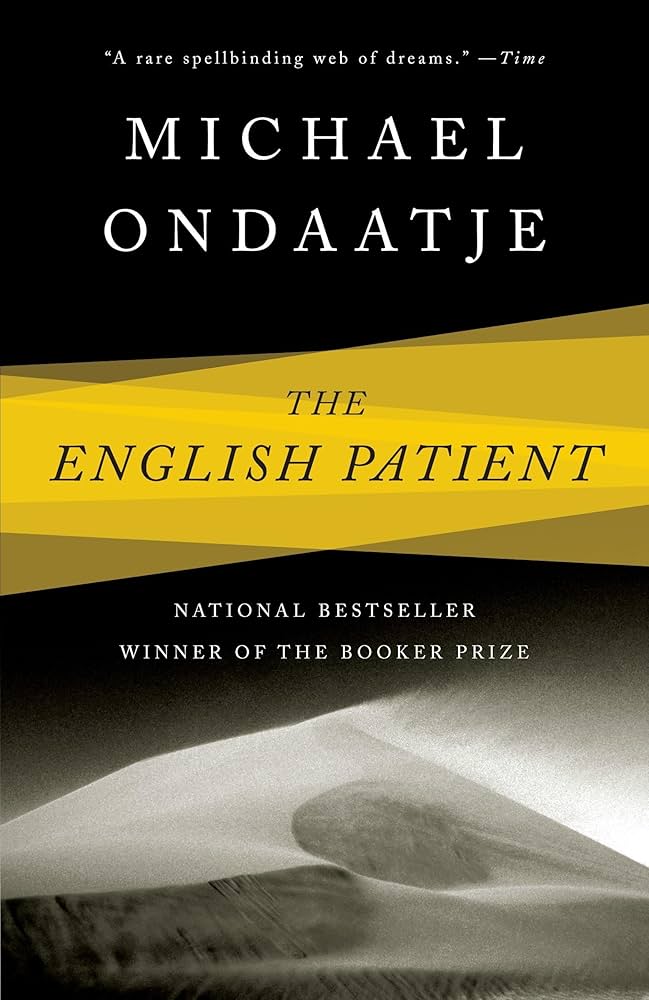
The battle lines of the Italian campaign in World War II have moved northward from the outskirts of Florence. In a villa once owned by the Medici and then the Jesuits, lately used as a hospital by the Allies, two people remain. One is a nurse, a young Canadian woman who has been tending soldiers as the armies worked their way up the Italian peninsula. Bucking order, she has stayed in the villa to tend the English patient, a man who has been burned nearly beyond recognition, and who she says is too fragile to be moved any further.
At the beginning of the book, Ondaatje establishes how she cares for her patient, washing him every four days, bringing him food and water, injecting him with morphine, reading to him at night in the empty villa. “She reads to him from whatever book she is able to find in the library downstairs. The candle flickers over the page and over the young nurse’s talking face, barely revealing at this hour the trees and vista that decorate the walls. He listens to her, swallowing her words like water.” (p. 5) She also tends a garden, and ventures occasionally to other nearby settlements to barter for necessities, but otherwise there is only the English patient and the nurse, whose name is Hana. She is tending her own, inner, wounds as she keeps her last patient alive.
Though Ondaatje writes that Hana has tended the Englishman for months, it is apparently only when they are alone in the villa that he begins to recount his story, telling how he came to be so badly burned, how he came to be among the British army moving through Italy. The novel is divided into ten chapters, and it moves back and forth through time roving from the present when the war has left the characters behind back to the 1930s, as the nurse, the patient, and eventually two other men reveal varying amounts about their pasts.
It was impossible for me to read the novel without thinking about the excellent 1996 movie adaptation, starring Ralph Fiennes as the patient, Juliette Binoche as the nurse, with Willem Dafoe and Naveen Andrews as the additional two men who wind up at the villa and Kristin Scott Thomas as a fateful woman from the patient’s past. The lush and intelligent adaptation won the Academy Award for best picture in 1997, and it’s one of the few cases I can think of where the movie is at least as good as the book. One of the key questions of the story is whether or not the patient is actually English, and thus on the Allied side, or not, and thus possibly someone who worked for the enemy. Having seen the movie, I knew the answer, and so any suspense about this point was displaced into consideration of how it was shown, or concealed. I was reading less for the content of the story than for the aesthetic experience that Ondaatje offered.
As the seasons turn and the year begins to warm, Hana and the patient are joined at the villa by a third person, another Canadian named David Caravaggio. He starts as something of a patient, too, with bandages covering much of his hands. He and Hana knew each other back in Toronto before the war, with Caravaggio having been a good friend of her father’s. He had also been a high-class burglar. In due course his story comes out: he had worked for Intelligence before and during the war, putting his thieving skills into service for King and country. Latterly, the Germans had captured him in Italy, but instead of shooting him out of hand, they had cut off both of his thumbs. Thus the bandages when he turns up at the villa, and the morphine habit.
The fourth is Kip Singh, a Sikh sapper who started his time in the army as a bomb disposal man in London who joined the rest of the army when his mentor, the eccentric and brilliant Lord Suffolk, encountered a new kind of fuze that defeated his arts, and he was blown to bits, taking with him the only sense of home that Kip had begun to feel in England. Attached to an engineer unit, Kip defused mines and built bridges up the Italian peninsula. I suppose that Kip is not technically AWOL — Ondaatje has him leaving the villa regularly to clear mines elsewhere — but his attachment to any unit is extremely loose, a sign of the chaos that follows any army and that increases as the end of the war comes nearer.
The English patient was shot down over the Libyan desert, picked up by Bedouin (who took any identifying items, as such tags were considered lucky totems), nursed by them and carried across the desert, where he was handed over to the British. They, in turn, wanted to know what he had been doing in an airplane deep in the empty areas that were contested by British and German troops, so they kept him alive, kept him with their armies, and kept asking him questions. Eventually the official desire for answers became less pressing as the theater of war moved from North Africa to Italy, but military inertia kept him alive and captive.
In addition to the mystery of the patient’s past, the novel is a close examination of four people damaged in different ways by war, an excursion into belonging, and interlocking love stories of various sorts. It contains some disquisition on disarming bombs, the mentality necessary to do that job well, and what that does to a person under pressure of industrialized war. Caravaggio’s story shows what happens when insouciance meets military necessity, and also meditates on the meaning of vengeance. Peacetime explorers become pawns of empires; the Bedouin play both sides; the desert outlasts both lives and loves.
Occasionally, I struggled with the artful isolation of the villa. That depiction helps Ondaatje concentrate on his portraits; it keeps the book focused, and much of its power derives from how tightly it pays attention to the four and their shifting relations. On the other hand, the villa is just off a road that runs from town to town, and it’s only about 100 yards from the village of Fiesole; the characters’ separation from the world strikes me as the author’s artifice, a condition imposed to tell the story he wanted to tell, the way he wanted to tell it.
On one historical point, I have to take issue with the author speaking through Kip. On his crystal radio set he hears news about the dropping of the atomic bombs on Japan, and he leaves the villa in a rage, declaring that they would never have been used on a country of white people. First, I think Ondaatje is reading later knowledge of the horrors of atomic warfare backward into initial reports. John Hersey, for example, did not begin reporting from Hiroshima until May 1946, and radio reports in August 1945 would have been scant on details. Second, I don’t have any doubt that if the bomb had been available in the early months of 1945, it would have first been used on Berlin. The Allies had agreed on a Germany-first strategy of victory; Hitler was the top enemy; devastating his capital would have been the fastest way to end the war. Kip’s outburst could be seen as his having finally had enough of being practically alone among Europeans for five years. (Less charitably, it could be seen as the author needing to have him exit before the rapidly approaching end of the story.)
These are minor caveats to a lovely reading experience. Ondaatje has created unforgettable characters — though I am sure seeing them in a great movie helped in that regard — and he tells their interrelated stories with grace and beauty. He brings them together, shows how they change each other, and sets them loose in the world again. It’s a beautiful, crucial time for all of them as war somehow transformed into peace.

 Al Singh
 Doug Merrill
 Doreen Sheridan
 Emily Lauer
 John Pitzel
 Lars N. Goldschlager
 Laura Eilers
 Professor X
 Robert Maedgen
 Sylvere Ap Leanan
 The Shire
1 ping
[…] of Darkness 21: Julio Cortázar: The Pursuer 22: Claude Simon: The Acacia 23: Michael Ondaatje: The English Patient 24: Georges Simenon: The Man Who Watched Trains Go By 25: William Faulkner: Sanctuary 26: Rainer […]