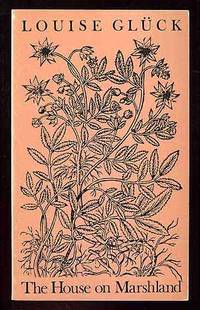
In her note at the start of The First Four Books of Poems, Louise Glück writes of her goals before and after The House on Marshland: “After Firstborn, I set myself the task of making poems as single sentences, having found myself trapped in fragments. After The House on Marshland, I tried to wean myself from conspicuous syntactical quirks and a recurring vocabulary—what begins as vision degenerates into mannerism.” In the thirty-five poems in this collection, divided into two sections — “All Hallows” and “The Apple Trees — there are indeed fewer fragments, though few of them are complete in a single sentence. The occasional ellipsis leaves its sentence open to further possibilities, and she remains fond of the held breath of the em dash. Fewer of these poems have scorpion’s tail that struck me about Firstborn; maybe seven more years of practicing poetry had given her more confidence in her full creations and less of a need to reverse them in a line or two at the end.
The poems in “All Hallows” are not all autumnal, though the title poem and “To Autumn” certainly are, while “The Magi,” “Nativity Poem,” and “Flowering Plum” bring other seasons to mind. “Gemini,” pairs with “Nativity Poem,” perhaps. “Jeanne D’Arc” and “Departure” face each other, though the former’s departure is both more permanent and more exalted than the latter’s.
The second section, “The Apple Trees” brings more places, love poems, unhappy poems, and the only work that runs more than one page, “Abishag,” which draws on the biblical story of King David and a young woman called to keep him warm in his old age.
I can see the craft in these works, see Glück stretching her range, writing about objects near and people mythical, writing about lovers so close to her speakers and intimate figures in their lives grown distant — but the poems have not really stuck with me. Which is fine.

 Al Singh
 Doug Merrill
 Doreen Sheridan
 Emily Lauer
 John Pitzel
 Lars N. Goldschlager
 Laura Eilers
 Professor X
 Robert Maedgen
 Sylvere Ap Leanan
 The Shire
2 comments
Hello Mr. Merrill,
I am writing a book on American authors where I produce a brief biography of the author followed by a paraphrasing of one of their works. It will include publicized critiques of the author and/or their work and finally a review by me. The reason for this letter is to make a contact with Gluck or her estate to gain permission to include the Gluck in the book.
The authors I have chosen for this book are the following: James Baldwin, Pearl Buck, James Clavell, James Fenimore Cooper, Bob Dylan, T.S. Eliot, William Faulkner, F. Scott Fitzgerald, Robert Frost, Louise Glück, Nathanial Hawthorne, Ernest Hemingway, Washington Irving, Harper Lee, Sinclair Lewis, Jack London, Herman Melville, Margaret Mitchell, James Michener, Tony Morrison, Eugene O’Neill, John Dos Passos, Edgar Allen Poe, J.D. Salinger, John Steinbeck, Mark Twain, Thomas Wolf. Half of these authors have won the Nobel Prize for Literature.
The book will be titled “My American Bookshelf” and is intended to interest young and old on the merits of the authors and their works and entice them to purchase the full novel. The proposed introduction to the book can be found at:
https://bedgell.com/Authors/IntroductionWEB.pdf
I am sure The House on Marshland is copy written so I need permission to take extracts from it but I can’t find who to contact to ask for permission. I am asking the copyright holder for a preliminary approval to use the material with final approval when I submit to you the completed work. I have a general cover letter and the section on Gluck I can mail or upload to my private web site so they can see the contents. I would hate to publish this work without Gluck, a Nobel winner.
Best Regards,
Bob Edgell
Author
Hello Mr Edgell,
Thank you for reading and enjoying our work at The Frumious Consortium!
I am afraid that I have nothing to do with the rights to any of Louise Glück’s work. My best suggestion would be to find a recently printed volume of her works, i.e., not an anthology, and to write the listed publisher. (I have one from Penguin Classics.) The publisher will likely have a rights and reprints department of some sort that can give better information. Keep in mind that English-language rights are often divided among various regions of the world, so this may be a complex task.
Good luck with your project!