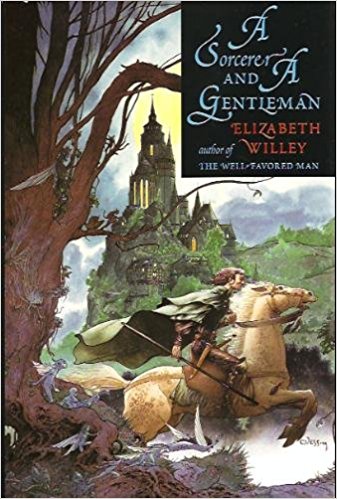
A Sorcerer and a Gentleman. One character who is both? Or two characters and one of each? Elizabeth Willey’s second novel, set in the same multiverse as The Well-Favored Man, offers numerous candidates for each appellation. She starts her story with an unknown person and the “proverb, often quoted but seldom applied, that all a gentleman needs to travel is a good cloak, a good horse, and a good sword.” In her second paragraph, she spells out what is more commonly applied, by detailing what a gentleman with just those three things lacks: “This man has no baggage but the saddlebags on his horse; he is alone, without a single servant to attend him; moreover, he is on horseback rather than in a carriage with the fine horse ridden by his lackey; and furthermore, he is plainly galloping … and his hair is blown about and his clothing disordered by the exercise. Lastly and most tellingly, it is night-time … long after sundown, a time when any true gentleman would long since have been snugly established in his chosen inn for the night with a good dinner and a bottle of wine.” (p. 9)
Having informed her readers that she will be playing with expectations about gentlemen, Willey then switches to a sorcerer, Prospero. Like the other Prospero, he is in exile, denied his rightful throne by a usurping brother. He, too, commands magical servants called Ariel and Caliban. He speaks less often in iambic pentameter than he did in The Well-Favored Man, but he does often enough for his mode of speech to be distinctive among this book’s characters. Unlike the other Prospero, this one has a daughter named Freia. She has accompanied him in exile to Argylle, a land he has either discovered or created, or perhaps a bit of both, with assistance from the magic of the Spring, which has given him command over the element of water. Prospero’s original home, Landuc, is in the realm of the Well of Fire. Other events not seen in the book have given him power over earth via the Stone in Phesaotois; he is also named Duke of Winds, though Willey does not say how he came by this title.
Willey next introduces Prince Josquin, and by way of accessories to him, the Emperor and Empress. Josquin is by definition a gentleman, but his first scene finds him recovering from prostration, and not from the usual pursuit of too much wine, but rather because another gentleman has played him false and caused him to fall into deep sleep for several days. Was the false player the person seen at the very beginning, fleeing with horse, cloak and sword? Circumstances suggest he was; they further suggest that he worked at least a minor sorcery on Josquin, quite apart from whatever charms caused the two of them to retire alone to the prince’s chambers.
The title can be weighed against each of the male characters as he is introduced, and kept in mind as events draw reactions from the people Willey depicts on the page. Who is a sorcerer? Who is a gentleman? Does the one preclude the other? Are these characters as they seem? Thinking back, I also wonder what questions Willey would pose for her female characters. They are equally vivid — Freia at once fierce and vulnerable, Luneté the Countess of Lys an enthusiastic young bride and mistress of her own realm, the sorceress Odile Prospero’s peer, and several others. Though Willey has chosen to tell a story mostly about the men of the worlds she creates, neither readers nor male characters should underestimate the women.




 the book before realizing that I’m not as decrepit as I thought, and ooh yeah, Yoon Ha Lee knows how to throw his narrative punches!
 Al Singh
 Doug Merrill
 Doreen Sheridan
 Emily Lauer
 John Pitzel
 Lars N. Goldschlager
 Laura Eilers
 Professor X
 Robert Maedgen
 Sylvere Ap Leanan
 The Shire