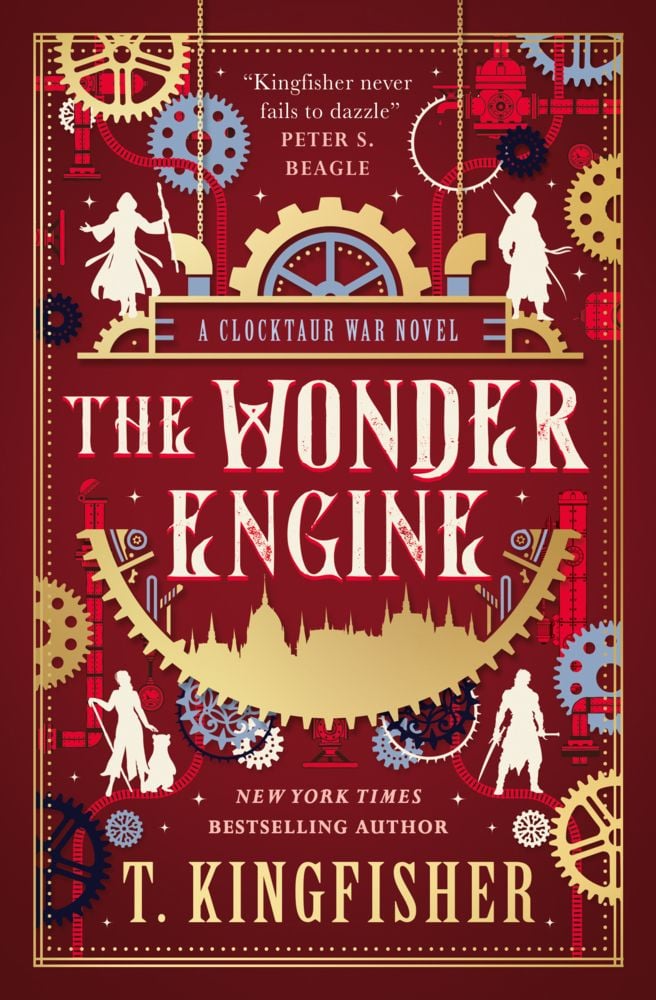
The Wonder Engine continues and concludes the story begun in Clockwork Boys. To recap: Three misfits have been offered reprieves from their respective criminal sentences (two death, one life in prison) if they can find a way to stop the Clocktaurs, semi-mechanical, semi-magical contraptions that are slowly but surely conquering the lands surrounding the misfits’ home city on a campaign clearly aimed at the city itself. The army’s regular forces have slowed the Clocktaurs some but by no means halted their drive. Previous missions to Anuket City, the source of the marauders, have failed or simply disappeared. It’s desperate measures all around.
As I wrote previously, Slate is a convicted forger with a death sentence hanging over her head; she also has the mild magical knack of smelling rosemary when danger is near. Brenner is her ex, an accomplished assassin and jack-of-all-crimes with a death sentence of his own. Caliban is a paladin who killed nearly a dozen people while he was possessed by a demon. The possession modified his guilt, in the eyes of the local law, and so he was not hanged but tossed into the dungeon forever. To keep them on task, all three were given magic tattoos that can cause them pain if they begin to stray from their mission, and kill them if they abandon it entirely. In Clockwork Boys, the three gained the assistance of a young scholar, the Learned Edmund, whose abstruse knowledge may be helpful in unraveling the mysteries of the Clocktaurs. More pragmatically, his order also had sent a senior scholar to Anuket City, and his correspondence contained hints about the Clocktaurs, but he, too, seems to have disappeared. If they can find him, maybe he knows how they work and how to stop them. Finally, the group gained a gnole named Grimehug.
Gnoles, in this world, are intelligent bipedal beings with badger-like features. They can speak human languages (humans cannot get far in gnole languages because communications often involve things like the position of a gnole’s whiskers or the angle of their ears) and have partly integrated themselves into human societies, often taking on menial jobs such as street cleaning or removing dead bodies. Like underclasses everywhere, they are often overlooked and underestimated. Gnole society is complex and caste-based; they are not immune to overlooking and underestimating either.
Clockwork Boys ended with the group arriving at Anuket City, and The Wonder Engine picks up moments later. As they enter, Slate remembers why she left the city (though Kingfisher does not make that explicit for readers), and that the Clocktaurs and whoever their masters might be are not the only dangers that await her. But with Kingfisher, the humor of people being themselves is never far away. They left their horses in a stable:
“Good riddance,” muttered Brenner. “Never getting one of those beasts again.”
“How do you propose to leave the city, then?” asked Caliban, amused. “Assuming we do?”
“On a sedan chair carried by voluptuous maidens.”
“Voluptuous maidens with very strong backs,” said Slate.
“Best kind, darlin.”
Learned Edmund made a small sound of moral pain. (p. 6)
As an outsider to the humans in the party, Grimehug gets some of the best lines. He has plenty of opportunity, too, because the interpersonal dynamics of the group are complicated. Brenner and Slate were partners in crime as well as lovers some time back; they know each other very, very well. He wouldn’t mind having another go, but he isn’t going to moon about it. She’s comfortable with him, and she knows he’s bad in general and bad for her in particular, but familiarity and being known have a strong pull. Caliban is smitten with Slate, but held back by his paladin’s guilt and the fact that he still has a literal demon within him. Brenner’s occasional possessiveness toward Slate rankles; Brenner knows that, and he’s not above saying things just to get under the paladin’s skin. Slate is about equally smitten with Caliban, but she can’t quite let go of her past with Brenner, and anyway she’s not going to bend and make the first move. Learned Edmund is colossally clueless, and prone to entering or speaking at inopportune moments. Kingfisher has great comic timing with Edmund’s appearances, much to the exasperation of the other humans in the group.
The way that [Slate and Brenner] had spoken together, almost with their own private language filled him with a gnawing envy. Brenner understood that part of Slates life in a way that the paladin never could.
Envy is a terrible emotion for a paladin[, thought Caliban]. Nearly as bad as pride.
“Twisting your own whiskers, big man,” said Grimehug.
Caliban opened his eyes. “Hmm?”
“You. Thinking. Smells like whisker twisting.”
“I suppose I am.”
“Humans don’t have whiskers,” said Learned Edmund. “Does this denote a painful act?”
Grimehug gave him a dubious look. “Hurts, yeah. But a gnole does it sometimes anyway. Knows a gnole should stop, but keeps twisting. You know?”
“I know,” said Caliban. “Believe me, I know.”
“Thought you might, big man.”
And a funny thing happens on the way to stopping the Clocktaurs. The mission fades a bit into the background, and the people take up the foreground. Sure, they undertake a series of actions that they hope will stop production of the deadly contraptions. Those get more complicated when Slate’s past in the city — which the group hopes to use to their advantage — catches up with her, and readers find out what Kingfisher did not reveal in the first chapter. Slate had a very, very good reason to leave Anuket City in great haste and never return. But The Wonder Engine is not a novel of plot, with gears clicking inevitably into place as action begets reaction, and events taking their course. It is a novel of character, of people, human and otherwise, knocking up against each other as they try to complete a dangerous mission. The Clocktaurs are seldom seen, and the danger to the group’s home city is known, but moment by moment what they do to each other holds more importance than the distant peril. They will not be able to complete their task without somehow coming to terms with each other, and each with themselves.
She was just feeling pleased with her own resolution when—predictably— Caliban said something stupid and she lost her temper again.
“You should have told us that you were at risk.”
Slate threw her hands in the air. “Oh, like you’ve been so forthcoming?Forgive me if I’m not rushing to tell everyone all about my past! Hell, I still don’t know how you wound up with a demon in your head, but am I lecturing you about it?”
She folded her arms and glared at him. …
Caliban took a deep breath, let it out, then closed the door. He stood clasping his hands behind his back. He stared at the floor.
Oh got, he’s at parade rest again[, Slate thought]. Why is this my life? Slate rubbed a hand over her face.
“Pride,” said Caliban.
He seemed to be waiting for a response. Slate said, “Err, what?”
“Pride,” said Caliban. “It’s a sin. In my case, a mortal one.”
“… okay?”
He lifted his eyes to her face. “No, I have not been forthcoming. It is not a story that reflects well on me.” (p. 101)
He tells the story, and indeed, it does not reflect well on him. His pride led to the deaths of about a dozen people, ended his time as a paladin of the Dreaming God, landed him in a dungeon and lodged the remnants of a demon inside of him. The conversation that follows leads to half of a breakthrough. Slate and Caliban are much more open to each other afterward, but they still hold some things back, and they are still on a life-and-death mission.
That echoes later in the story, when Slate is in captivity and facing prospects of a slow and painful execution.
Pride, Caliban [had] said. Pride was his sin.
Was this pride, then? Not wanting to break down in full view of people who remembered her name?
She thought briefly of Caliban—not her friend, but Lord Caliban, Knight-Champion of the Dreaming God. They said that he had asked for nothing at his trial, that he had stood silently while the charges were read and the names recited. That he had asked neither for mercy or forgiveness, that he knew he deserved neither.
Was this the same kind of pride he had at the end? The very last kind, the pride that where all you had left was that you did not wish a crowd to see you break?
She should have asked him. Gods, she had wasted so much time when she could have aksed the important questions—said the important things—kicked his damn stubborn-ass feet out from under him and showed him that the weak could take down the strong if they had the right bit of leverage. (p. 210)
The rollicking adventure returns, and funny moments are never far away, but at heart The Wonder Engine is a closely observed novel of character and feeling, one that succeeds at its dangerous mission.

 Al Singh
 Doug Merrill
 Doreen Sheridan
 Emily Lauer
 John Pitzel
 Lars N. Goldschlager
 Laura Eilers
 Professor X
 Robert Maedgen
 Sylvere Ap Leanan
 The Shire