
Isn’t this neat? Tokyo is one of the world’s greatest cities, and is regularly praised for its success on a human scale even as the population of the metropolitan area has soared past 30 million. In Emergent Tokyo: Designing the Spontaneous City, Jorge Almazan and his team of more than two dozen researchers and editors try to answer crucial questions about the city. What are some of the key features that make Tokyo so vibrant and appealing? How did they come about? Are there underlying patterns? Can these successes be sustained, or maybe even replicated and extended? As they write, “But to use Tokyo as a source of inspiration, one must move beyond the awed gaze of the tourist and begin to ask questions about the why and how of the city. That, in a nutshell, is the purpose of this book.” (p. 4)
The authors also warn throughout the book about just-so stories of the unique Japanese-ness of Tokyo and its development. Cities and cultures the world over have their unique aspects, but people in Tokyo were also responding to economic, legal and environmental challenges that have counterparts elsewhere. The choices that they made began patterns that contributed to Tokyo’s unique character, and path-dependency means that the options in other places will be different. The authors hope that showing underlying mechanisms can both contribute to greater understanding of Tokyo itself and help people, especially decision-makers, grasp the dynamics in their own cities so as to make more human-centric choices. Tokyo’s successes are neither impenetrable nor perfectly reproducible, but understanding how they emerged can make corresponding successes elsewhere more likely.
The bad news is that the answer to almost any question posed about Tokyo begins with, “It’s complicated.” The good news is that with diligent work and thorough research, comprehensible patterns emerge. “Instead of reducing the city’s diversity to a singular Tokyo model, we conceive Tokyo as having multiple neighborhood models or archetypes, each with its own distinct urban fabric—areas which are similar in terms of land use, street patterns, and building types, even if they’re on opposite ends of the city. (p. 7) The team describes their approach:
Tokyo’s metropolitan government now offers a wealth of quantitative information about every building, road, and plot of land in the city, data which can be analyzed algorithmically to lay bare the differences between Tokyo’s diverse neighborhoods. By poring through government databases, we have pinpointed several key characteristics of Tokyo neighborhoods that strongly predict their other contours, enabling us to compare and contrast at the scale of the city in concrete, quantifiable terms. For example, neighborhoods with a similar building scale and mix of land use often resemble each other in subtler metrics as well, such as their permeability to the public, accessibility for pedestrians, and the intimacy and vibrancy of their communities. Through this analysis, one can begin to grasp a common pattern language across Tokyo neighborhoods and gain a sense of how their essential characteristics give them a distinctive tenor and daily rhythm. (p. 7)
The research team took advantage of a long-standing city practice of dividing the city into small administrative units known as chōme. The full city has 23 wards, but within these wards each chōme is only about 0.2 km2 in area. By analyzing the city chōme by chōme, the researchers found six major archetypes: Village Tokyo, Local Tokyo, Pocket Tokyo, Mercantile Tokyo, Yamanote Mercantile Tokyo, Shitamachi Mercantile Tokyo, Mass Residential Tokyo and Office Tower Tokyo. The archetypes differ in their density, balance of residential and commercial building, scale of developments, street sizes, and other characteristics. The authors found that neighborhoods of a given type often had more in common with each other than with their immediate geographic neighbors.
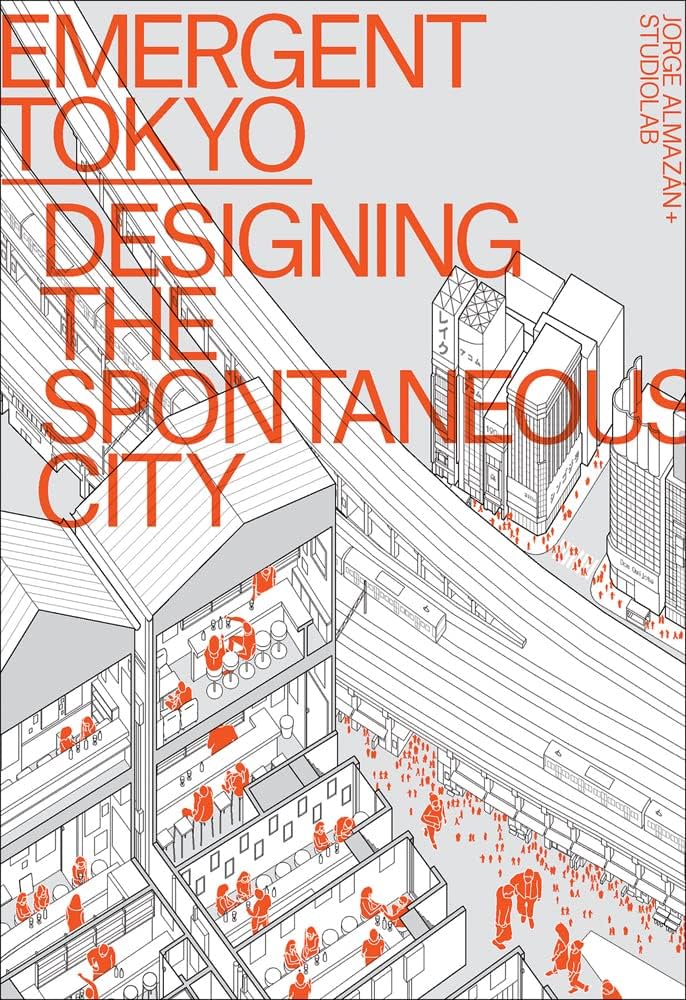
One great advantage of this book being produced by an architectural team is its visual quality. The discussion of the neighborhood archetypes has a color-coded map showing where the different archetypes occur. The map includes train and subway lines so that a reader can immediately see how development fits with transportation. Each of the archetypes also receives an illustration, so that the description of Village Tokyo — “A continuous fabric of densely packed two-story, single-family houses … [with] some mid-rise buildings, like schools and housing blocks are scattered throughout the area” (p. 9) — lodges in a reader’s mind as more than just words. The mix of high-rise commercial and residential buildings that enclose neighborhoods of narrow alleys in Pocket Tokyo is visually very different from the 1960s housing blocks and super-tall 2000s towers of Mass Residential Tokyo. These are pictures that are worth far more than a thousand words, especially when making comparisons or referring back to initial concepts after reading more detailed descriptions later in the book. My only complaints are that the orange color and smaller font chosen for secondary text are not always as readable as I would like. Otherwise, the photos, maps, visualizations and infographics on more than half the pages make Emergent Tokyo an excellent work of visual communication. The case studies show exactly what the authors are talking about in their general descriptions, with photos, cross-sections, maps and perspective drawings providing granular detail.
Having come up with the archetypical neighborhoods, the authors zoom in even more closely and describe five different types of construction that they contend are characteristic of Tokyo. For each type, they provide three case studies so that readers can see variations as well as themes. In recounting the histories of how these buildings came to be, the authors show the importance of government oversight (or the deliberate lack of same) as well as the financial incentives for owners and renters. They do not believe that isolation from either politics or commerce is sustainable, and they are not shy about describing the messy processes that have produced contemporary Tokyo. Several commercial categories, for example, emerged from the black-market period at the end of World War II. The occupation authorities initially tolerated a great deal of black market activity because they believed it was necessary to begin economic recovery and they did not have the administrative capacity to stop it. Over time, efforts to regularize these markets shaped the emerging commercial landscape of post-war Tokyo. The colorful alleyway businesses and micro-sized bars and restaurants, the yokochō alleys made famous by the Golden Gai, sprang from this background and are now a characteristic part of Tokyo. But as the generation that started these businesses is passing from the scene, they need a different framework if new entrepreneurs are to keep them going. The districts also face a balancing act: the micro-businesses are part of what makes an area attractive, but they will never generate the tax revenue of large-scale developments.
Emergent Tokyo is brilliant at capturing these layers of complexity while also working hard to show patterns, tendencies and solutions. If there is an overarching tendency that the authors favor, it is creating space for adaptability. Top-down has to be able to meet bottom-up, and authority — whether public or corporate — works best when it is setting up frameworks, not in dictating every detail. I may never get to visit Tokyo again, and I will almost certainly never live there, but this book has taken me back to the heart of the city, shown how it works, and how the ways that Tokyo emerges could also show up in other cities. It was a pleasure from start to finish.

 Al Singh
 Doug Merrill
 Doreen Sheridan
 Emily Lauer
 John Pitzel
 Lars N. Goldschlager
 Laura Eilers
 Professor X
 Robert Maedgen
 Sylvere Ap Leanan
 The Shire