
Oh, boy, am I the worst person to send a speculative fiction mystery to when the mystery is, at best, mid. And that’s the thing: these mysteries could be so good, and have so much to say about the human condition as we hurtle into infinity, if the ideas were at all fleshed out and given room to breathe.
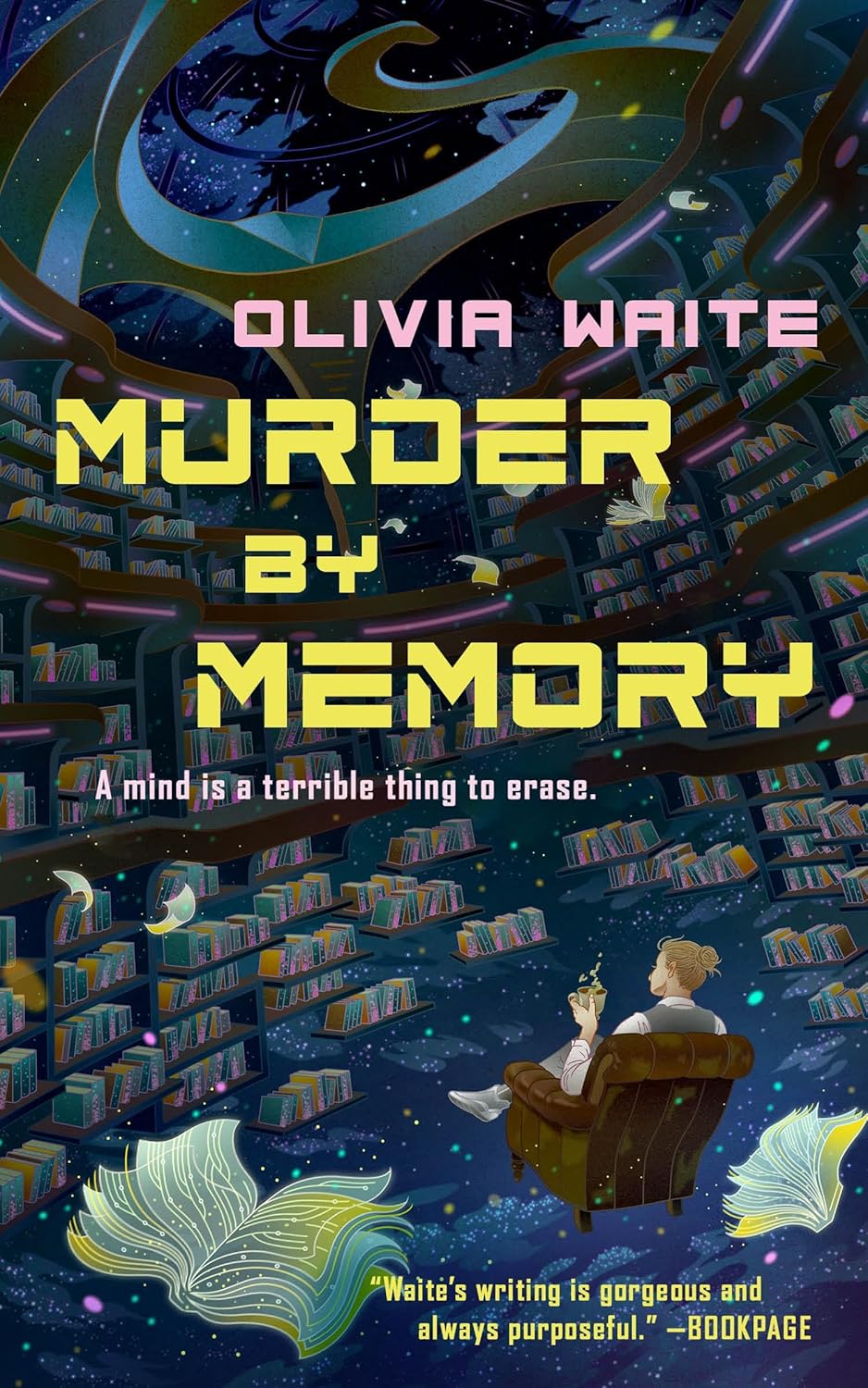 Which is a bit ironic given that being fleshed out is one of the core technologies at the heart of these novellas. The basic premise is that instead of generation ships carrying humanity to new life on a distant planet, the inhabitants have the ability instead to write their memories and personalities into digital books stored in the ship’s Library. These can then be re-downloaded into newly created bodies based on each individual’s own genetic codes when their old ones expire, whether from natural causes or otherwise. The people aboard the HMS Fairweather have thus been alive for centuries.
Ship’s detective Dorothy Gentleman had elected not to be immediately reborn after her latest death, and has essentially been hibernating for the past two years. She’s thus startled, as Murder By Memory begins, to find herself rudely awakened, and not in a body corresponding to her own. Instead, she wakes up in an elevator, her personality and memory abruptly thrust upon another’s in an emergency action that the ship’s computer Ferry has deemed absolutely necessary.
It seems that while the ship is weathering a magnetic storm, some of the books in the Library have been damaged beyond repair, including Dorothy’s. Given her importance to the ship, Ferry shunted her consciousness into the first available body, knowing it would be able to sort everything out later. But another emergency has come up: there’s been a murder aboard the Fairweather. And who better than the newly reanimated ship’s detective to solve it?
What follows is a clever but entirely too rushed story that I had to re-read several times to fully understand. The problem is that the trick of the murder mystery lies entirely in the original but barely explained technology. As far as sci-fi goes, it’s brilliant. As far as a mystery goes… well, it’s actually pretty bad. Mystery readers want to be part of an investigation, to puzzle out the conundrum with the detective. When answers basically show up deus ex machina, the mystery reader (me, it’s me) feels robbed, especially when I have read and enjoyed plenty of other cross-genre novels that carry off both genre remits with aplomb (see: books by Mur Lafferty, Robert Jackson Bennet and Curtis C Chen, among others.)
But even the sci-fi reader in me is rather perturbed at the way the worldbuilding feels so hastily delivered. Each case is compressed into less than 150 pages, and I genuinely cannot figure out why. Is this a capitalism? Or is the author somehow unsure of her own abilities, preferring to just power through the stories instead of presenting a fully formed world for readers to explore. Ironically, I’m a huge proponent of shorter mystery novels — most do not need to break 300 pages, let alone 400 — but only when they’re set in the real world, with commonly acknowledged and understood rules of behavior. The more background you need to give on the setting and customs, the higher the page count you need. When that setting is glittery new sci-fi, and the mystery itself dependent on technology that’s pretty much unique to the setting, then you definitely need more pages for set up.
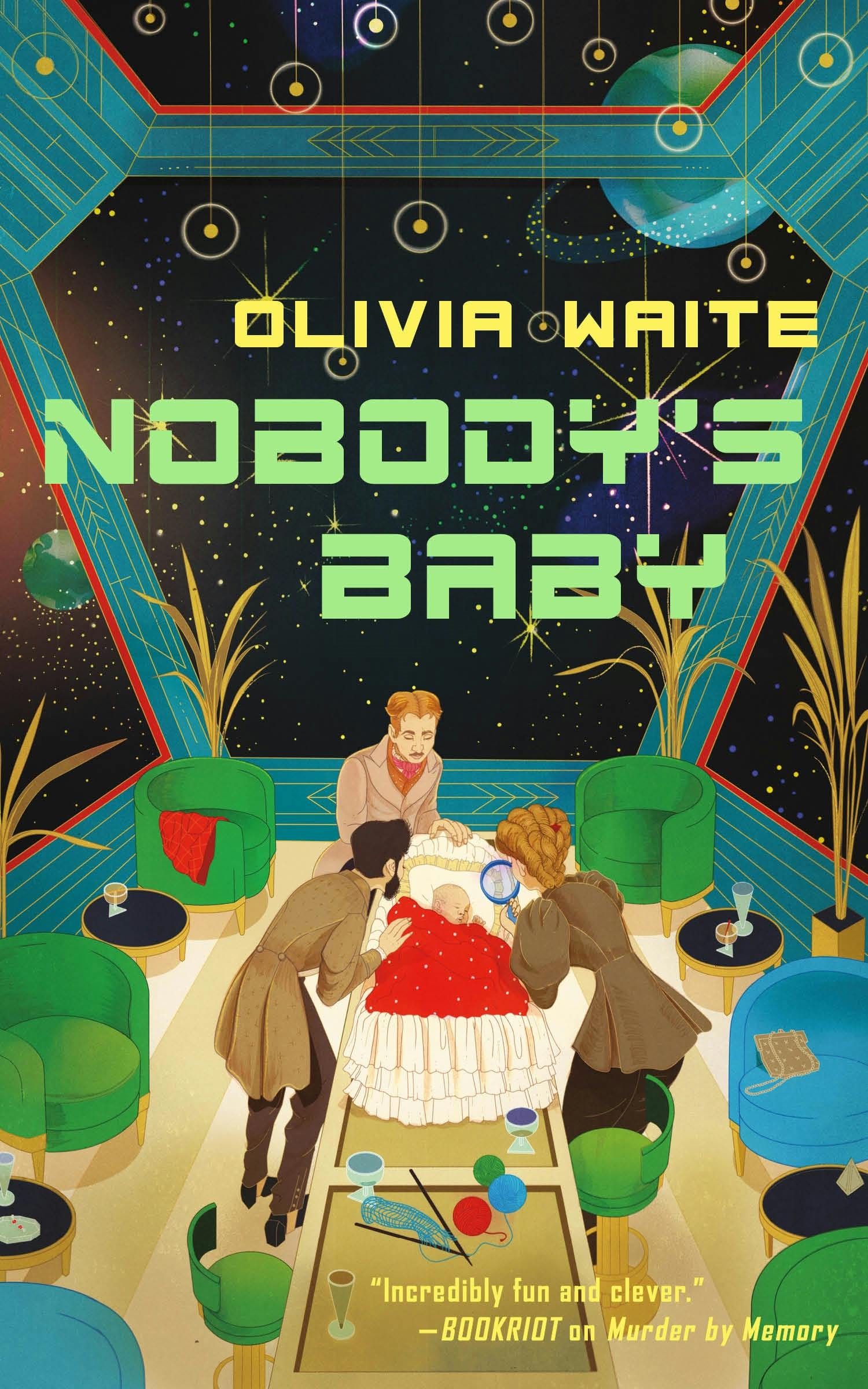 Perhaps unsurprisingly, I felt that the second book in the Dorothy Gentleman series was slightly more successful, as we’d already established our ground rules in the first novella’s pages. Nobody’s Baby expands further on how the practice of immortality essentially prohibits procreation. When a baby unexpectedly appears, however, it’s up to the ship’s detective to get to the bottom of the case. I thought that the custody agreements regarding the baby had more than a hint of wish fulfillment to them, which is fine. I was mostly baffled by why there was no mention of what might happen to the killer — and yes, there is a murder here. The question of punishment in a criminal justice system where people cannot die is fascinating to me: will justice be punitive or restorative or some mixture of both? I can deal with it being mentioned in passing, but not with it being skipped over altogether (and saying the case would go to Crime Committee doesn’t count.)
I was also completely unconvinced by the idea of someone as allegedly smart and sensible as Dorothy giving what she did to Violet. Please. She’s supposed to be terribly clever and observant but she behaves more like your slightly above average intelligence 20-something than a seasoned investigator.
And while I can grin and bear the hints of greater mystery regarding everyone’s pasts, it only feels worthwhile if I’m given something substantial to chew on in the novellas themselves. These are almost that but a lot of the time, I feel like I’m merely chewing on the illusion of a story. There is certainly a smorgasbord of ideas here, but it never quite comes together in a way that satisfies. I definitely found it more agreeable to read these all at once than separately tho, like how you need greater quantities of junk food than nutrient-rich food to feel full. If you’re here primarily for the sci-fi ideas and the positive representations of diverse sexualities, then these novellas are great. You probably won’t like them if you expect a well-constructed mystery tho.
That said, 10/10 to the covers, especially for Nobody’s Baby.
Murder By Memory by Olivia Waite was published March 18 2025 by Tordotcom and is available from all good booksellers, including
Nobody’s Baby by Olivia Waite was published March 10 2026 by Tordotcom and is available from all good booksellers, including

 Al Singh
 Doug Merrill
 Doreen Sheridan
 Emily Lauer
 John Pitzel
 Lars N. Goldschlager
 Laura Eilers
 Professor X
 Robert Maedgen
 Sylvere Ap Leanan
 The Shire