Kara’s Uncle Ed owns the Glory to God Museum of Natural Wonders, Curiosities and Taxidermy. It’s a highlight of downtown Hog Chapel, North Carolina, and in all its glorious weirdness, it was a childhood sanctuary. Uncle Ed likes nearly everyone he meets, bless him, and he’s ecumenical in his beliefs, but he’s also getting up in years. His knees are not what they once were, and his gout has come back. When Kara, the first-person narrator of The Hollow Places whom everyone calls Carrot, winds up in a tight spot after an unexpected divorce, Uncle Ed persuades her to come and help him mind the shop. Or in this case, the museum. He even has a spare room upstairs in the back, so that’s her housing problem solved, too.
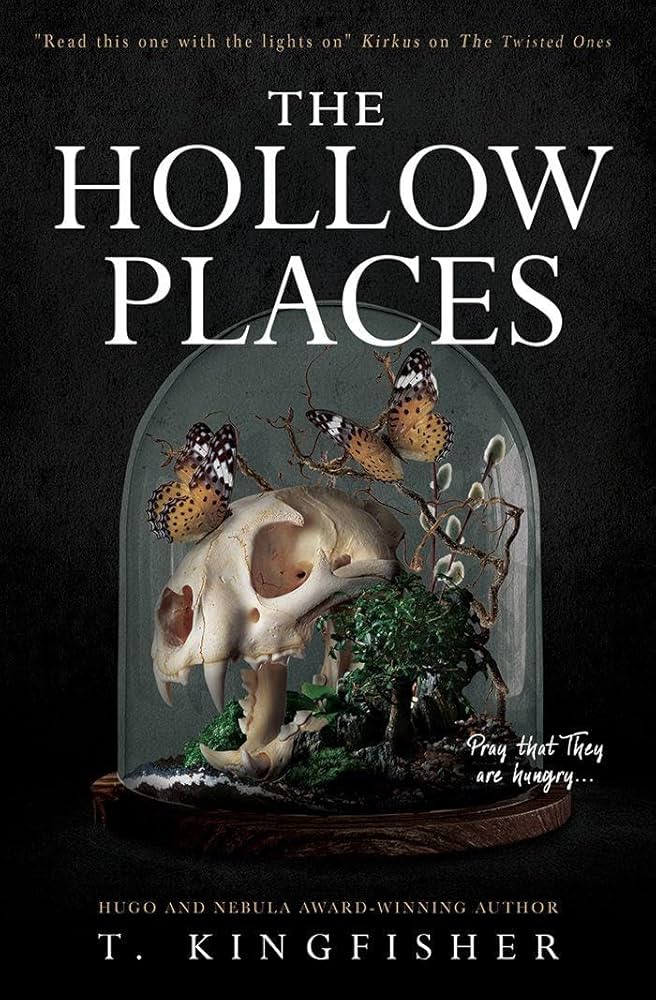
A ramshackle old building full of “eleven stuffed deer heads, six stuffed boar heads, one giraffe skull, forty-six stuffed birds of various species, three stuffed albino raccoons … two jackalopes, an entire case of dried scorpions, a moth-eaten grizzly bear, five stuffed prairie dogs, two fur-bearing trout, one truly amazing Amazonian river otter, and a pickled cobra in a bottle” (p. 2) all just on the first floor, is not everyone’s cup of tea. But Carrot grew up there, and it all feels like a cozy come to her. Even if there are a lot of glass eyes that might be looking at you.
Uncle Ed’s call comes as she is packing up in her soon-to-be-former home.
“Heard you were having a rough patch, Carrot.”
“Well, these things happen.” I had an immediate urge to downplay the divorce, even though I had been sobbing furiously about half an hour earlier. “I’ll manage.”
“I know you will, hon. You were always tough as an old boot.”
From Uncle Earl, this was highly complimentary. I laughed. The tears were still a bit too close, so it came out strangled, but it was a laugh. (p. 9)
When he offers, she does not hesitate.
My ex-husband had visited the Wonder Museum once and told me the place was “kinda freaky” so all my memories of the Wonder Museum were good ones, without him in it. I could wander around the dusty cases and pet the stuffed grizzly and make the armored mice reenact the end of The Empire Strikes Back.
Hell, I could actually catalog the damn collection and earn my keep.
“Really, Carrot?”
“Reallly.” …
I thanked him a few more times and hung up, and then cried on the bookcase for a while.
When I finally stopped, I wiped my eyes, then I took all the Lovecraft and the Bear and left Mark wt the Philip K. Dick because I never liked androids anyway. (p. 10)
By the time that Carrot is actually moving in, Uncle Earl has not only tidied her room, he has installed the stuffed head of a Roosevelt elk, with a “rack of antlers like tree limbs” (p. 13) on the wall opposite the bed. He was a childhood favorite that young Carrot had immediately named Prince, after Bambi’s father, the Prince of the Forest. This leads to a side note from Carrot the narrator, “Everyone goes on about how disturbing Watership Down is as an animal book for kids, but it doesn’t hold a candle to Bambi. (p. 14)
The Wonder Museum shares its building with a coffee shop, the Black Hen, run by Simon, the owner’s barista brother.
Simon was interesting. He dressed like a thrift-store Mad Hatter, with fingerless gloves and strange hats. He looked exactly the same now as he had the last time I had been here, five years ago, and exactly the same as he had when I’d first met him, nearly a decade ago. Simon had to be nearly forty, if not older, but he looked about eighteen Somewhere, a portrait was probably aging for him.
Uncle Earl and I drank free at the Black Hen because Uncle Earl owned the whole building, and I think he took at least half his rent in caffeine. Simon loved the Wonder Museum and came over sometimes with interesting skulls, also in lieu of rent.
“How’ve you been, Simon?” I asked, flopping down in one of the chairs while he filled up a carafe for me to take back.
“I’m good,” he said. “I hear you’re not so good.”
“Divorce.”
“Ugh. Do I need to kill him?”
Simon was approximately half the size of my ex, but it was an arresting mental image. “No, but you’re sweet to offer.” …
“Aww. You’re better off. Men suck.”
I raised an eyebrow.
“Sorry, it’s the eye talking.” He put my coffee on the counter.
“…the eye,” I said.
“Oh, you haven’t been around for a while! Yeah. Turns out my left eye’s got some rare form of color blindness that only women get. So they think I’m probably a chimera and ate my twin in the womb and it’s actually her left eye.”
I sipped the coffee. It was extremely good coffee. “Huh.”
“The optometrist got very excited.”
“I bet.”
“Sometimes I see weird shit with it.”
Knowing Simon, weird shit could encompass anything from ghosts to auras to invisible aliens performing in a barbershop quartet. I thought about asking if he’d seen anything in the Wonder Museum, but given that it was wall-to-wall weird shit, how would he even tell? (pp. 18–19)
It’s a good thing that Simon has his eye, and that Carrot has whatever she has, because they are both about to see some weird shit. Uncle Earl’s knee finally gives out; he needs surgery and several weeks of rehab, none of it to take place at the Museum. After a few days of running the Museum on her own, Carrot finds that some customers have knocked a hole in one of the upstairs walls. Or at least that’s what she thinks. Home repairs, or indeed Museum repairs, are not her thing, so she asks Simon for some help.
“It’s gonna need the big patch to put in,” Simon frowned. “I’m gonna need to find a stud.”
“Don’t we all,” I said, not quite under my breath. Simon grinned.
He took out his phone, turned on the screen, and stuck it into the hole, angling it to the side, then peered into the hole. “Let’s see where the…”
He stopped.
He turned the phone the other way and turned his head to look.
“No stud?” I asked after a few seconds.
“Um,” he said. “Carrot, you might want to take a look at this.”
Simon backed away from the hole and held his phone out to me. He sounded calm, but it had a strange, brittle edge.
My heart sank. There would be leaking pipes or exposed asbestos or something. Something expensive.
I shone the light through the hole.
There were no leaking pipes. There was no stud.
I was looking into a dark hallway that vanished out of the light, in both directions.
“Ugh.” I pulled my arm back. “Isn’t this over the coffee shop? Isn’t there supposed to be more of a wall?”
Simon looked at me. “I don’t think you quite understand. That’s not the coffee shop.” (pp. 36–37)
The corridor has a concrete floor, which it shouldn’t have. It runs a distance that would reach to the end of the block in both directions, which it shouldn’t do. Then it turns and opens up into a room, with high-water marks on the walls, which would put them out over the street and implies that water should have been flowing into the Museum and the Black Hen at some point. Only when the Museum’s cat shows up behind them, startling both and making Simon think they’re about to be eaten by brain goblins (“That’s just what I thought when I saw the eyes, ‘Oh, shit, it’s brain goblins.'” (p. 45)) do they do the sensible thing and turn back.
Readers are readier to come to the conclusion than Carrot and Simon are, but they get there soon enough. “If this were Narnia, I’d expect more fauns, and maybe some Turkish delight. And I don’t even like Turkish delight. The first piece I had tasted intensely of rose, which means it tasted the way that Head & Shoulders shampoo smells, and I have never gotten over that association.” (pp. 60–61) No fauns, no Turkish delight, and at least one too many dead bodies, as they discover when they return to the peculiar corridor, cautiously and with a bit more equipment. The other thing is, the wall is not staying patched.
The Hollow Places takes a creepy premise, and then follows it well into scary. Simon and Carrot keep doing sensible things, and keep finding that their premises were wrong, so that what seemed sensible was a really bad idea. They find out a bit more about how the dead body got that way, and then they find more, and then they find things that are worse. The two of them never lose their grounding, never lose their senses of humor, which makes the dire situations all the more distressing. Kingfisher keeps them just on the verge of fixing their problems, only to find that the solution won’t quite work, and may make the situation worse. There is a whole lot more on the other side of that hole in the wall, and it’s fascinating, but it’s also utterly imperative to close the hole, and for reasons that make sense within the story, Carrot and Simon cannot call on anyone else for help. It’s a damned close-run thing.

 Al Singh
 Doug Merrill
 Doreen Sheridan
 Emily Lauer
 John Pitzel
 Lars N. Goldschlager
 Laura Eilers
 Professor X
 Robert Maedgen
 Sylvere Ap Leanan
 The Shire