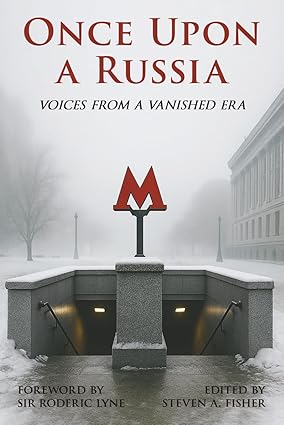
Once Upon a Russia, which carries the subtitle “Voices from a Vanished Era,” collects slightly more than 100 short essays from Westerners who lived and worked in Russia after the collapse of the Soviet Union. It’s a personal project, born of a 2024 reunion with a friend and colleague that “unfolded into hours of nostalgic storytelling, half-forgotten names, and generous pours,” as Fisher notes in his acknowledgments. (p. 237) What makes this more than just recollections among buddies is the remarkable address book that Fisher built up over sixteen years as a senior banker in Moscow and Kyiv. The ambassadors, financiers, analysts and entrepreneurs whose recollections — alongside those from people in less exalted professions — fill the book write with great openness about a historical moment that has passed.
They came to Russia, they found hope, adventure, not a few found love and fortune, and they have all now left Russia. Most of them kept the love and fortune that they found there, all of them recall the adventures, but the hope, by and large, is gone. The time that the writers lost hope and left varies — some as early as 2008, some as late as the winter of 2022 when Russia launched its full-scale war of aggression against Ukraine. Some of the writers think that a time may come again when the Russia that they experienced, a Russia full of people seeking freedom and excited about the possibilities of the future, a Russia integrating with international institutions and at peace with its neighbors, a Russia that acknowledged and was beginning to welcome the diversity of its citizens, will be the face that Russia shows the world. None of them expect it to come soon.
The vignettes in Once Upon a Russia tend to follow a pattern: the writer’s initial contact with the country; the excitement, challenges, and life-changing experiences of living in Russia; the disillusionment, whether gradual or precipitous; the departure, and regret for what might have been. Some of the writers had previous experience with the Soviet Union, a few during the Brezhnev years, most during Gorbachev’s era of opening and reform. Several of them were in Moscow during Yeltsin’s confrontation with the Communist-dominated parliament and saw first-hand how people came out on the streets to defend their newly-won freedoms. Some brought with them deep knowledge of the language and country, honed by study or family connections. Others arrived with nothing more than curiosity and enthusiasm. In numerous cases, Russia was not initially welcoming, but as the contributors persevered, opened up unexpectedly. The writers built lives, they built companies, they integrated deeply in Russian life and society, mostly in Moscow but others across that vast land. Some of the diplomats returned again and again — Sir Roderic Lyne, who wrote the volume’s foreword served three times in the country and was the last head of the UK Soviet desk — before their regular rotation elsewhere. Other writers left of their own accord. Many, though, left because the advancing years of Putin’s rule made it impossible for them to stay. Harassment, confiscation, corruption — all increasing with time — led to their much-regretted departures. I didn’t count the number of who stayed until the 2022 invasion of Ukraine, but it was a noticeable share.
My own story with life in Russia followed the pattern. I was a trailing spouse. My better half — who is fluent in Russian and did her dissertation on social policy in non-Moscow regions — was recruited in mid-2011 to lead a British NGO. I arrived with the kids at the start of 2012, and we settled in to what we hoped would be an interesting tenure. I had visions of visiting Baikal, seeing St Petersburg, maybe making it all the way to the Altai, which we had almost approached from the Mongolian side a decade earlier. I started language lessons even before the move — I still chuckle about the moment the teacher exclaimed, “My God! You speak Russian like a Polish aristocrat!” — and was looking forward to doing better with Russian than I had with Georgian. (Georgian’s hard. My reaction to switching to learning Russian was What a nice, well-behaved language. I gather that this is not typical.) Moscow’s winter was as hard and glorious as expected. I loved the slightly dodgy internet company I found work with. My colleagues were smart and interesting, and our interdepartmental meetings never lasted more than 20 minutes, a model of good communication and efficiency. Our supervisor was a blue-eyed Muslim woman who wore a head covering; a friend who wanted to be a filmmaker was astonished that I had never heard of Andrzej Sapkowski; one colleague had come to Moscow from the Altai, another from the southern steppes, still others were native Muscovites. I even had a brush with Wild East business: I was offered a nominal ownership stake in the company, because as an American person I would give the company a better position when it fought credit-card chargebacks made by US customers. I spoke with a friend who by that time had been involved with property development for several years, and who is a contributor to Once Upon a Russia. He said that while having nominal US owners had been a common practice a few years earlier, it was no longer a good idea. I managed to find a diplomatic way to refuse the offer.
I don’t know if it would have had longer-term repercussions for my employment because my better half was getting squeezed out of the country. When she was hired, Russia looked to be changing from an aid recipient to an aid donor. It was looking to deepen its participation in the G20 and G8 international groupings. By the time that I arrived in early 2012, Putin’s party had stolen the 2011 parliamentary elections, closing the door to multi-party democracy and precipitating the largest street demonstrations since the fall of the Soviet Union. Soon afterward, Putin announced that he would return to the presidency in 2012, sidelining Medvedev and giving notice that Russia would be returning to personalist rule. The mission for which my better half had come to Moscow had become impossible, and the NGO’s international office did not want to see that. (Their record during that period is checkered.) We left at the end of the school year; I returned later in the summer to close down our apartment and ship belongings onward to Berlin. We were not alone. Not long after our departure, the Russian government gave notice to USAID that they would have two weeks to close down all projects, after about 20 years of cooperation.
Our story would fit well with those told in Once Upon a Russia. At two pages each, they are necessarily snapshots, but they capture the energy of free Russia, they show some of its contradictions. They present numerous points of view and counter the myth of a monolithic people. They also show significant moments in the writers’ lives, and sometimes little moments that mark history.
The reappearance of imported fruits—especially bananas—was a true cause for celebration. Bananas had become virtually impossible to find in Soviet times, reserved for special occasions or smuggled in from abroad. Now, with the shift toward an open market, they—and other exotic fruits—arrived in abundance, and people could not get enough.
As a keen photographer, my eyes were drawn to an overflowing garbage bin outside Gorky Park on a late Sunday afternoon in the summer of 1992. The resulting image provides a visual reminder of how, in the 1990s, bananas became the snack of choice—consumed with abandon, as if people were trying to make up for all the years they had been denied this simple pleasure. The joy was not just about the fruit itself but about the freedom that came with the choice to buy it at all. It was a taste of a world beyond the long lines and empty shelves that had once defined daily life.
The return of these foods … meant that people no longer had to rely on black-market deals or go without. …
Looking back now, that moment feels even sharper—a brief, heady time when the future seemed open, and even a banana tasked like hope. (pp. 64–65)
Rachel Polonsky is in Once Upon a Russia with a story about what kinds of phone calls you get when you lease an apartment from a former deputy chairman of the Presidium of the Supreme Soviet. Michael Tay, who served as Singapore’s ambassador to Russia, tells how a commission to write a string quartet grew into a full symphony about the idea of utopia and the work’s 2005 premiere at the Tchaikovsky Concert Hall. Stories range from traffic to decadent nightlife (the founder of the legendary Hungry Duck bar is a contributor) to lost dogs and lasting friendships.
Phil [a repatriated Russian American] had imported $20 million in American agricultural equipment, determined to revolutionize Russian farming. We had spent the night [in 1998] at the dreary former collective farm that served as his base.
As we wandered the complex, we noticed a young man, perhaps nineteen, meticulously cleaning the massive wheels of one of the new combine harvesters. The wheels, nearly as tall as he was, didn’t need cleaning—they were built for the dirt, destined to roll through it every day.
Phil approached him. “You don’t have to clean those,” he said gently. “They’re designed to work dirty.”
The young man turned, gesturing toward the crumbling buildings around him. “Look where I live. Look how we live. My friends drive Russian combines—metal boxes made of scrap that rattle your bones. In the 40-degree [Celsius] sun, they roast in those ovens. My father did too.”
He paused, his voice steady but his words charged with pride. “And I sit in this. A glass cabin, air-conditioned, with a chair like a throne that has a shock absorber. There’s a stereo and a CD player. I cruise across the fields, music blaring, flying high. I feel like a god. And I was nothing, I had nothing. How could I not wake up in the morning and clean this machine?” (p. 86)
Unfortunately, the story has a second half, one that does not involve a farmer who works hard and appreciates his tools.
Phil dedicated himself to transforming lives, to building a better Russia. He built a beautiful estate near Rublyovka for his family—a dream realized, but one that came with a price. One of Vladimir Putin’s prime ministers took a liking to the estate and seized it without compensation. Phil was allowed to keep his freedom, but not much else.
Like Phil, I came to understand that those in power did not share our values. They took what they wanted, and the price was paid by those trying to build something better and the people they were trying to help.
Today, Phil lives in America. (pp. 86–87)
The last of the book’s five parts is titled “Desolation.” One of its 13 stories details how Putin’s personal commitment to control and corruption was already present in 1992 when he worked in the mayor’s office in St Petersburg. He first questioned why food aid was necessary (amid a post-Soviet collapse in distribution to hospitals, orphanages and schools) and then commanded that future deliveries would be subject to his personal oversight. The next-to-last story is about the murder of Boris Nemtsov. My better half knew him when he was governor of Nizhny Novgorod, and I met him at a future-oriented conference on Long Island in 2000. He was very tall, and spent most of his time on his cellphone. More than a decade has passed since he was shot from behind just minutes from Red Square. The last story took place in Prague, where the author was living and working for a Russian company, not long after the full-scale invasion of Ukraine.
One afternoon, while playing mini-golf with my son, a little girl approached us and spoke in Russian. “Hi, I’m Maria. I speak three languages—Russian, Ukrainian, and Czech.”
Then she added, with solemn pride, “My father couldn’t come with us. Someone had to stay home and take care of our cat.” …
The cruelty of war isn’t abstract. It’s a child in exile trying to explain her father’s absence with a story that’s easier to bear.” (p. 234)
Once Upon a Russia makes me think of Atlanteans, remembering what has sunk beneath the water. I, too, turn and regard the waves.

 Al Singh
 Doug Merrill
 Doreen Sheridan
 Emily Lauer
 John Pitzel
 Lars N. Goldschlager
 Laura Eilers
 Professor X
 Robert Maedgen
 Sylvere Ap Leanan
 The Shire