Oh gosh, I don’t even know how to write about this book, but I strongly suspect that it was just not For Me, as I struggled to empathize with the main character (not a problem I ordinarily have!)
 And I get it, middle school friendships are hard and occasionally stupid and definitely prone to sudden splintering at that age. At thirteen, my friends and I had a weird falling out over, of all things, where we wanted to play rounders during recess. The pressure for conformity is perhaps most brutal — and most deeply felt — at that age. Relationships shift and fracture, sometimes for good.
Adding diverse sexualities to the mix can make kids feel even more alienated. In progressive circles, not being heterosexual is no longer something to be shunned, which is a great thing in and of itself. Unfortunately, this puts pressure on kids who just don’t care about that kind of thing to pretend that they do, since there’s no longer an “excuse” for being quiet about their crushes (tho in reality, there’s always an excuse, if your crush is taken or older or otherwise not socially acceptable.) Jerks will pressure kids who don’t have crushes to conform, while the more well-meaning will assure them that liking someone will happen eventually.
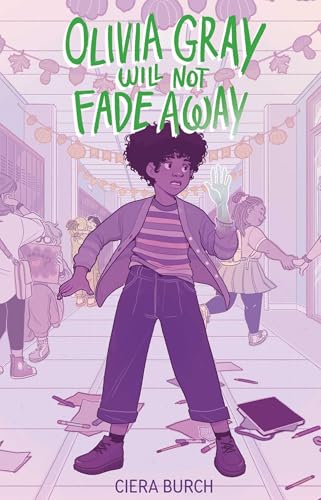
For sensitive asexual/aromantic kids who already feel overlooked and unseen, this can feel like erasure to the point of invisibility. And that’s pretty much what happens to our title character Olivia Gray. Her older brother was her best friend until he got a boyfriend and no longer has time for her. Her group of school friends all seem more interested in boys and social status (powered by the unlikely new app KruShh) than in whatever it was they used to talk about. And her favorite school adult, the now-former librarian, has retired without a word to her.
When she starts getting these weird staticky, tingly feelings, the last thing she expects is to actually disappear. She makes a friend, Jules, who’s in a similar situation, but decides that the best way to fix things is to pretend that she has the same romantic feelings that all her old friends do, roping Jules in to her playacting. Things don’t go well. Can Olivia find a way to stick up for herself and be seen by the ones she loves most, before she disappears altogether?
So I get the desire to be seen while simultaneously not wanting to be looked at. You want people to love and accept you for who you are without you having to explain anything. This is an appropriate feeling for children. Becoming an adult, however, means understanding that we live in a society, where people’s instinctive viewpoints come, of necessity, through the lens of their own experience. There’s a stat in the books that states that almost 2% of people in the US are ace/aro, so it’s honestly not that strange that people wouldn’t know a lot about it.
The challenge is just to state who you are and stick by it in a way that works for you. This is a test that Olivia fails repeatedly and poorly, making it hard for me to sympathize with her. She’s super dramatic and self-centered in a way that reads less like she’s being overlooked and more like she’s a killjoy who can’t be happy for the people she claims to care about. Sure, it’s hurtful when your closest confidante is deep in the throes of his first relationship and no longer has time for you. But it felt like she never really tried with Maggie and, to a lesser extent, Elaine, until the very end. It’s one thing to not want romance for yourself, but blanking everyone else’s interests unless they align with yours is just bad friend behavior.
Worse, she pretty much treated Jules the way she herself didn’t want to be treated. It felt like she was terminally incapable of being happy for her friends and their interests, whether newfound or otherwise, unless they made sure to center her. It’s hard as a reader to be sympathetic to someone who decides to internalize everything as a slight instead of making a greater attempt to be a friend herself.
Which, y’know, that’s a lot of kids that age! And figuring out that you’re ace/aro is a struggle on top of all the usual middle school drama. But it was genuinely weird to me the way that people, Olivia included, wouldn’t just accept that there was no one she was crushing on. That’s so normal, whatever orientation you are. This felt more like an adult complaint — hearing the litany of “Why are you still single? When are you getting married? When are you having kids?” is legit annoying for grownups — being presented rather awkwardly in middle school format instead.
I’m always for more ace/aro representation, tho think there’d be more value in being clearer about the distinction, as asexual people do have crushes and want fulfilling romantic relationships (I know fewer aro people irl but the ace people I know are mostly married to people who understand their orientation.) This book might serve as a primer for kids who think they might be ace/aro, but I’d personally hesitate to place Olivia herself as any sort of role model. And while I’m usually pro role-playing game representation too, the D&D appearance at the end felt just as forced as the rest of the novel.
Olivia Gray Will Not Fade Away by Ciera Burch will be published tomorrow March 17 2026 by Margaret K McElderry Books and is available from all good booksellers, including

 Al Singh
 Doug Merrill
 Doreen Sheridan
 Emily Lauer
 John Pitzel
 Lars N. Goldschlager
 Laura Eilers
 Professor X
 Robert Maedgen
 Sylvere Ap Leanan
 The Shire