
with an introductory essay by Owen Hatherley
After two books on Soviet bus stops, an eccentric topic from a world that’s receding into history, photographer Christopher Herwig turned his attention to a slightly more expected topic: stations of various metro systems across the former Soviet Union. This book echoes its predecessors in size and style. It has the proportions of a postcard, but it is a bit bigger in both height and width, and it runs about 250 pages, most of which are given over to full-page or almost-full-page photographs.
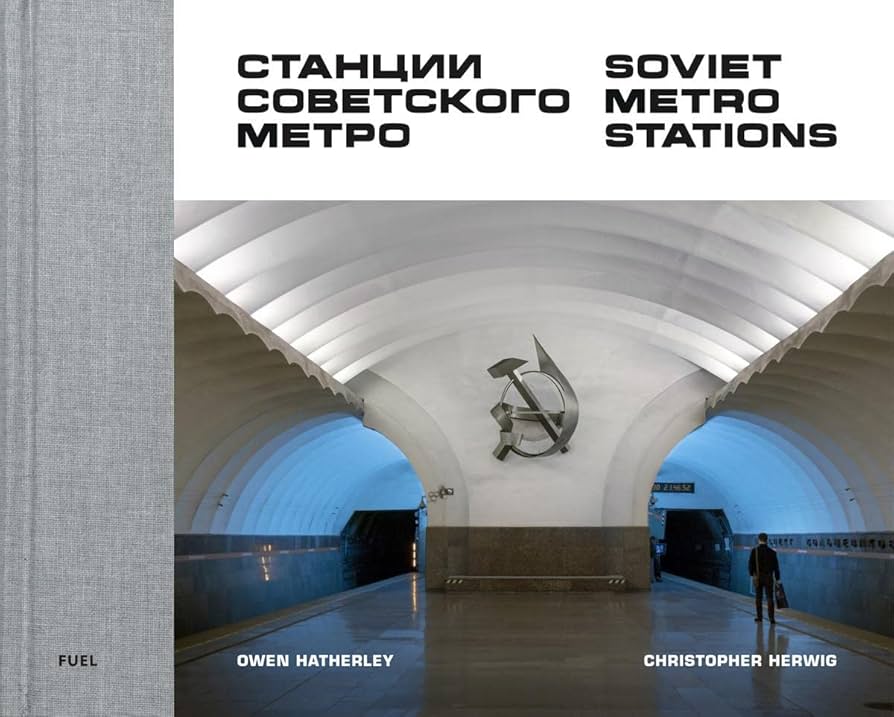
One nice aspect of the book is how much space it devotes to the systems outside of Moscow. The Moscow Metro is amazing, both monumental and functional — I used to commute on it — an epic achievement now within sight of its centennial and still growing. It is the longest system anywhere in the world outside of China; at some stations, trains arrive every 90 seconds. Moscow could fill the book with plenty of material left over, but Herwig and his essayist Hatherley have wisely chosen to look more widely, to consider Metros and their meanings across the full territory of the former USSR. Hatherley’s essay begins with Moscow, the first Metro and the model for all the others, and then proceeds across the former USSR in the order that the systems were built. The second section is on St Petersburg and Kyiv, both in cities that had different names when their metros were started. The stages of the systems’ development reflect first the state of the Soviet system that built them and then later the moods and capabilities of the post-Soviet era. For example, the oldest stations on St Petersburg’s Line 1 continue the epic and peculiar grandeur of the early Moscow lines: palaces for the people with art depicting heroic labor and the inevitable triumph of the communist system. Stations that were designed during the Khrushchev or Brezhnev eras are more prosaic, reflecting the larger shift from monumental constructions to improved material conditions for a larger share of the population.
Outside of Russia, the mandate for the metro systems also included reflecting the culture of the titular nation of the republics in which they were built. This, too, changed with priorities in the center. Tbilisi, Georgia opened in 1966, and its relatively restrained first line shows the effects of budget shifts. The line in Baku, Azerbaijan, opened the next year, featured “much more in the way of mosaics, gilding and general bling.” (p. 20) Throughout his introduction, Hatherley has interesting perspectives on relations between Moscow and the provinces, and how that was reflected in the architecture of the various Metro systems. Soviet planners and builders always regarded the systems as political statements, ideas made material, in addition to their functions as transportation systems. At times, that laid bare the contradictions inherent in communist practice. For example, systems in the non-Russian republics were supposed to display national history and culture; on the other hand, the architects were almost always Moscow-trained and/or Russian. Real power always remained in the imperial capital.
The republics that succeeded the USSR have been left with the legacies of these monuments. Removing or covering Soviet symbols — hammer and sickle, Red Army, Lenin — defaces significant art. Leaving them preserves daily reminders of oppression. Hatherley disdains advertising and other recent developments in building the systems, and his writing is generally weaker on the 35 years that have elapsed since the end of the Soviet Union than on the period in which these systems were conceived and begun. The Baku system, for example, was under Soviet management for 24 years; it has been Azerbaijani for a decade longer as of this writing, and the money flowing in from the oil boom has surely had an effect, but he gives this no real consideration.
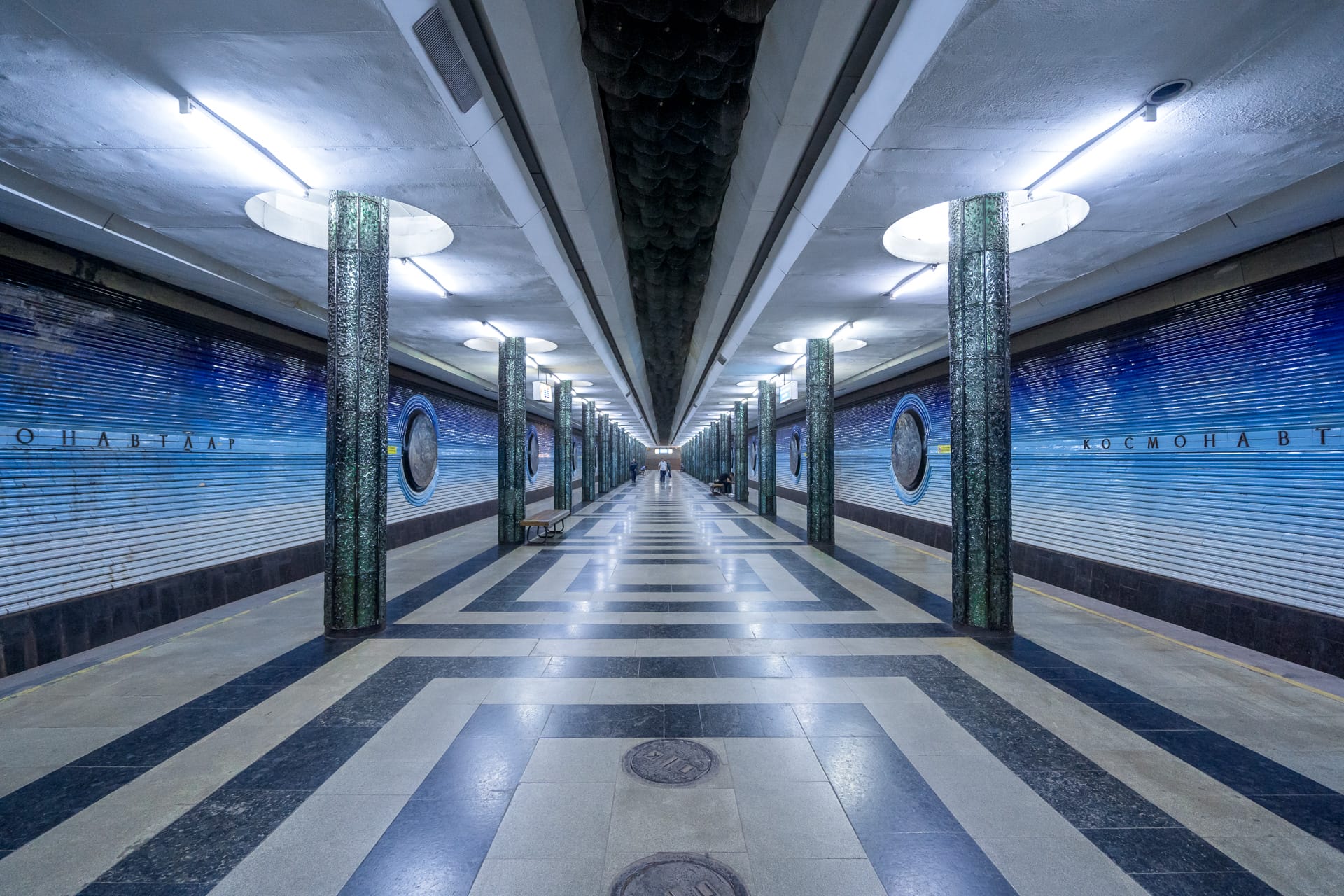
Hatherley does catch some of the peculiarities of the systems that have carried over from Soviet to post-Soviet times. For example, the Moscow Metro was initially considered a military installation because of its potential double use as a series of air-raid shelters. (Russia’s full-scale invasion of Ukraine, three years after this book’s initial publication, has of course made that potential a reality in Kyiv and Kharkiv.) That led to restrictions on photography in some systems. Tashkent, for instance, forbade taking pictures until 2018. Fortunately, Herwig journeyed there after the ban was lifted; one of Tashkent’s stations is pictured above.
Soviet leadership decreed that every city with a million or more inhabitants should get a Metro. Sometimes this lead to chicanery to boost population figures, and improvised traffic jams to impress visiting planners with the need for the relief that a Metro would bring. Hatherley describes how this was done in Yerevan, Armenia. It’s an example of the large-scale corruption that was as much a part of the Soviet system as May Day parades.
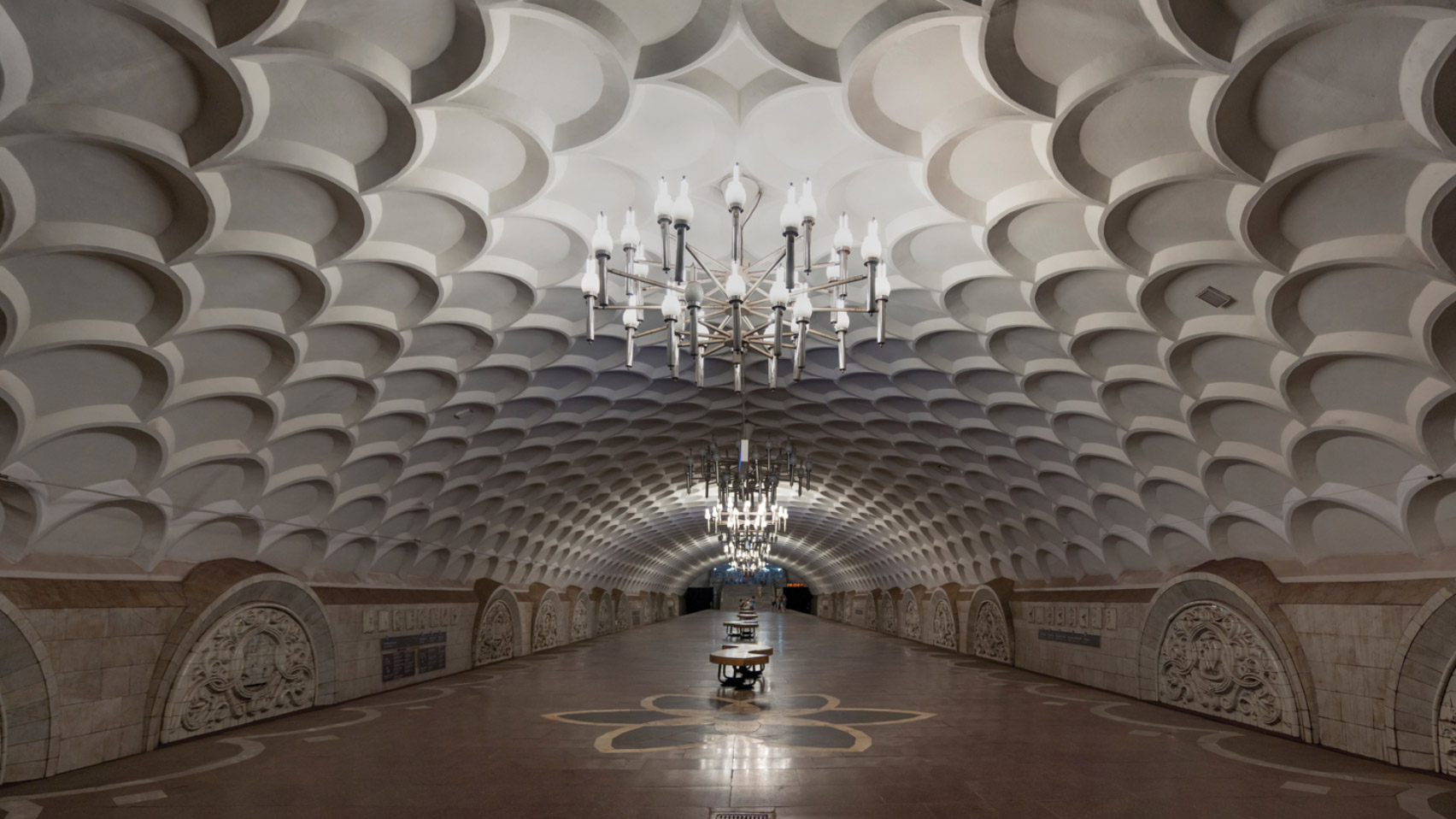
The design of stations in Kharkiv, with “an enormous continuous-span single vault” (p. 22) became a standard throughout the Soviet Union and in other countries as well. The system in Ukraine’s second city was also “the first to be clearly conceived as a coherent whole since the 1950s”, with all three lines “composed into an ensemble, where each line has its own stylistics.” (p. 23) Going beyond the obvious candidates is a virtue of this book; as Hatherley points out, “The 1980s actually saw more Metro construction in the Soviet Union than any other decade — eight Metros were either completed or substantially built.” (p. 26) (On the other hand, Moscow has added stations at a blistering pace in the 21st century, and the scale of building metros in modern China dwarfs anything else on Earth.) Herwig has pictures from Minsk, Nizhny Novgorod, Krivyi Ruh, Dnipro, Yekaterinburg, and others.
His style of photography will be familiar to readers of the Soviet Bus Stops books. All the photos are horizontally aligned, and most of them strive to catch the scale of the stations. People are generally not present, or visible in the distance. Detail shots are of artworks within the stations, or made to capture the textures of wall and ceiling decorations. In any reasonably sized book, the photographer can only hope to provide a sample of the systems. Visiting so many places meant that Herwig chose breadth over depth; photos from Samara and Yerevan and Tashkent means that there are fewer from any given place. Soviet Metro Stations winds up as a slightly peculiar book. As a commercial proposition, it’s an obvious extension of the bus stop project. As a selection, it’s aesthetically pleasing, and it’s a good start for a non-specialist. On the other hand, it doesn’t have the cock-eyed whimsy of bus stops, and it does not attempt to do anything more than introduce its vast subject. Its very nature reminds a reader of how much more there is to say and show.

 Al Singh
 Doug Merrill
 Doreen Sheridan
 Emily Lauer
 John Pitzel
 Lars N. Goldschlager
 Laura Eilers
 Professor X
 Robert Maedgen
 Sylvere Ap Leanan
 The Shire