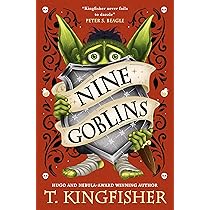
Nine Goblins is not just the story of nine goblins, one elf, and some weird things that happen, it’s also the origin story of T. Kingfisher. Under the author’s real name of Ursula Vernon, she had a successful and award-winning webcomic named Digger and more than a dozen published children’s books. But she had more stories that she wanted to tell and, as she relates in her author’s note “I had run headlong into the great problem of writing children’s books, which is that you are not allowed to write certain things. Arson, murder, and stacking bodies like cordwood are frowned upon.” Vernon continues, “I often say that inside every children’s author is a frustrated horror author. It’s not an exaggeration to say that T. Kingfisher was that horror author.” So she wrote Nine Goblins “based on my love of Pratchett and James Herriot … and then discovered that no one had any idea how to sell a weird goofy novella by a children’s author, particularly a novella with such a high body count.” (p. 149)
Enter self-publishing. Despite hiccups in production and a decidedly non-systematic approach to advertising and promoting the book, Nine Goblins found an audience. As Vernon explains,
…year in and year out [the book] kept buying me groceries. It almost felt as if the goblins were taking care of me. Moreover, it was proof of concept. I could write a book for adults. Suddenly I had something to do with various stories floating around that were definitely not children’s books.
So I wrote another one. And another one. Nobody stopped me. Eventually T. Kingfisher was getting bigger royalty checks than Ursula Vernon, and T. was allowed to swear in interviews. (p. 150)
Nine Goblins is where it all began. And it begins with gruel for breakfast. The goblins of the Nineteenth Infantry begin nearly every day of the war by having some gruel to get them going. It doesn’t matter much where they’re going, or why. The Nineteenth — better known as the Whinin’ Niners — are grunts, and they know it. The higher-ups may or may not know what they’re doing, but the lower-downs know what they will be doing. Camping out, moving out, and if they are unfortunate duking it out with the enemy. In the broader sense, the goblins know why they are fighting: human expansion has pushed them almost into the sea, so there was no choice but to turn and fight. In the narrower, day-to-day sense, who really knows for sure, and anyone who does know isn’t telling the Niners.
No sooner has Kingfisher introduced the goblins, and given a reader almost enough information to tell them apart but probably not yet enough to keep all of the titular nine straight, than she switches to an elf named Sings-to-Trees. Sings, as he is often called, is unusual among elves by really and truly caring about other creatures in the forest. This often leaves him in less-than-elfy circumstances, as in his first scene where he is, not to put too fine a point on it, “buried up to the shoulder in the unpleasant end of a heavily pregnant unicorn. Bits of unicorn dung, not noticeably more ethereal than horse dung, were sliding down his arm, and every time the mare had a contraction, he lost feeling in his hand.” (p. 11) Good thing that this is a T. Kingfisher book for adults and not an Ursula Vernon book for children.
The first parts of Nine Goblins are mostly slapstick and sardonic observations, even when the goblins find themselves in battle, and Sings pushes through exhaustion to tend to other creatures that have made their way to his haven. Most of the goblins are not very bright, and Kingfisher has fun with them, though never meanly. She plays off their haplessness against the good sense of their sergeant Nessilka, who somehow holds her unit together, and the sporadic genius of Murray, who had been busted down to the infantry for being too good at his job in the Mechanics Corps. Sings-to-Trees, for his part, repairs the leg of a creature he had not previously encountered, a skeleton deer, which his dubious references say is drawn to unusual manifestations of magic.
Things go as expected for the goblins, even in the midst of battle, until rather suddenly they are not in the battle anymore. Things go as expected for Sings-to-Trees, too, even when a group of goblins turns up in his neck of the woods, especially when one of them turns out to be injured. Just another creature that needs tending. What none of them expect, though, is a magical call that promises to make sense if they will just come closer to it. The voices will surely become distinct, the words understandable. Closer.
That leads to some horrors. For example,
There were cattle in the town square. Some of the humans had died when the cattle crushed them. It was a mess, a horrible mess, which was a laughably ineffective word for the scene before them.
At least if [Nessilka] thought of it as a mess, she didn’t have to think of it as people. (p. 109)
The conflicts in Nine Goblins are not straightforward, and they do not develop quickly, but when they do arrive, they add tension to the slapstick and the jollity such that losing even one of the goblins would be tragic. Given that they are in a wrong place at a wrong time, and plenty of people on the other sides would kill them all just to make things less complicated, it’s a surprisingly tense story. Quite apart from the horrors.
Nine Goblins proved it’s possible to mash up Pratchett and Herriot, that Ursula Vernon the children’s author could get laughs and still let her horror writer out, and launched T. Kingfisher. What’s not to like?

 Al Singh
 Doug Merrill
 Doreen Sheridan
 Emily Lauer
 John Pitzel
 Lars N. Goldschlager
 Laura Eilers
 Professor X
 Robert Maedgen
 Sylvere Ap Leanan
 The Shire