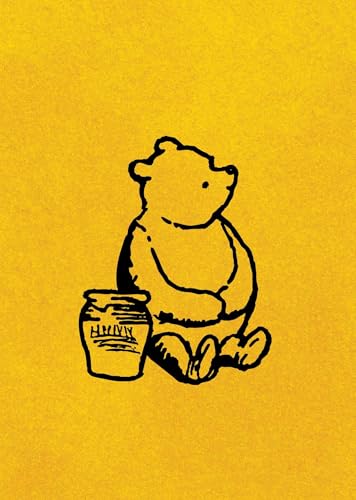
 collecting both the original Winnie-the-Pooh short story collection as well as its follow-up, The House At Pooh Corner, in one delightfully velour-covered volume reminiscent of a particularly huggable (and decidedly yellow) stuffed animal friend.
I did not, unfortunately, have a Winnie the Pooh childhood. I only really came to the property in my adolescence, after reading some A A Milne at my best friend’s house (she absolutely had a WtP childhood) and being affected by my younger sister’s obsession with cute tchotchkes, driven by the marketing of global corporations like McDonald’s. For a time in my mid to late teens, I even had the cutest backpack that looked like Pooh Bear clinging cozily from my shoulders.
But, like many others worldwide, I hadn’t actually read all the books in the series. I’d read the first book and one (or both, my memory is hazy) of the poetry volumes, courtesy of the friend I mentioned earlier. I don’t think I’d ever had the opportunity to read The House At Pooh Corner, with its surprisingly moving ending. I suppose the bittersweet conclusion is a metaphor for childhood’s end but, as someone who was shipped off to boarding school myself, I can see where the ending is less a gift to the actual Christopher Robin and more an attempt to assuage the author’s own guilt at being the herald, if not outright engineer, of same.
Honestly, I can’t tell whether I like this book better or worse for the way it resurrected those old feelings: better, probably, because as James Baldwin taught us, having my feelings recognized this way makes me feel less lonely. And overall this is a delightful volume, with charming stories perfect for imaginative children, accompanied by the wonderful original illustrations. It is hard for me, as a grown-up in the big 26– oh, no, wait, my 14 year-old is telling me we’re not carrying that designation over from last year, it’s the GRAND 26. Ahem. It is hard for me, as a grown-up in the grand 26, to completely divorce my visual impressions of the book from the iconic Disney animated versions tho. In the books, Pooh is described as having a gruff voice, which definitely took me out of the story for a moment as I struggled to reconcile that with the default adorableness of Disney’s Pooh Bear. This shouldn’t be a problem for younger readers who’ve acquired less media saturation, or so one would hope. I will say that I didn’t feel like the Disney version did anything but enhance the stories first told here, and make them accessible to a wider audience.
But I also think that the original stories are definitely worthwhile, especially as collected here in the centennial edition. Pooh might think he’s just a bear of little brain, but he’s also quite a good poet, and the tales of how he engages with his community set a fine example of how we should all care for and be kind to one another. This volume in particular is perfect for collectors, as well as for kids and caretakers who want to have a soft little snuggle over a bedtime story.
While performing background for this review, I came across the biography of the real Christopher Robin. It’s a little wild to think of how Mr Milne was a precursor to the controversial family vloggers of today, tho hopefully that sad story will serve as a warning to others seeking to monetize their children. Mr Milne wasn’t even as awful as some of the influencers exploiting their kids, but the scars left on Christopher Robin by his unexpected fame were lasting and led to significant family estrangement. It’s a good thing that these books at least have a shot at building closeness between kids and their caretakers, no matter what happened to the original writer and inspiration.
Winnie-The-Pooh, 100th Anniversary Edition by A. A. Milne & Ernest H. Shepard will be published tomorrow January 6 2026 by Aladdin and is available from all good booksellers, including

 Al Singh
 Doug Merrill
 Doreen Sheridan
 Emily Lauer
 John Pitzel
 Lars N. Goldschlager
 Laura Eilers
 Professor X
 Robert Maedgen
 Sylvere Ap Leanan
 The Shire