
Doug Merrill: Hi everyone!
Emily Lauer: Hello!
Doug: Hi Emily!
Doreen Sheridan: Hello, all! I can confidently say that I’m happy they started a poetry category (and that my favorite won, lol)
Doug: I’m glad that there’s a poetry category, too, and glad that it seems to have gone over well this year. Now to read them and see if I have more to say than that!
I wonder of Maria Dahvana Headley’s Beowulf would have gone into that category a few years back, rather than Best Related Work.
Emily: It is always interesting,to look back and see what would have gone in the new category when a new one is created. I feel like a translation is still a separate thing, though.
Doreen: I wouldn’t have been surprised if it had gone into a poetry category and won (says someone who’s only had time to read the first page of it so far). Heard great things tho, especially from Doug!
Doug: I’ll stan her Beowulf all over again! Translating is a thing, and poetry is a thing, and translating poetry is still another thing. I think I bounced off of four or five Iliads before Emily Wilson’s finally did the trick and I zipped through it in like three weeks. Kinda doubt there is enough translated poetry for it to become a separate category. I’m of many minds about a translation Hugo.
Emily: It’s SO GOOD. I read it aloud with my Reading Epics Aloud Group over zoom, when we were all isolated for the pandemic, and it was such a lovely time.
Gosh, a translation Hugo is quite a thing to contemplate. I mean, Emily Wilson would certainly be eligible, too, in that case.
Doug: I also gotta say that the notes in Headley’s Beowulf and Wilson’s two Homers are also terrific.
I think there has been on-again off-again talk about a Best Translation Hugo, but there are so many things to iron out.
Emily: Speaking of Related Works, I thought Speculative Whiteness was well done. I picked it up at a conference and then was pleased to see it being acknowledged.
Doug: I’m glad a book won!
Emily: And I was also interested to see that the Diana Wynne Jones podcast won an award since I just did a Diana Wynne Jones project, too! Perhaps this is the DWJ zeitgeist.
Doug: Maybe it is! Did you listen to the podcast? Or would that have impinged on writing up your thoughts on DWJ?
Emily: I have a Messed Up Ear, so I don’t listen to podcasts, but I’m in a DWJ Discord server, a DWJ Facebook group, and a DWJ emailing list, and they all discussed it a lot!
Doug: Nice! I haven’t really made room in my life for podcasts, so missing out on this one was not an exception. I don’t vote in the category in years when I’m a Hugo voter.
(“Nice” about the discussions, not the Ear, just in case that was ambiguous.)
Emily: I’ve never voted in the Hugos but I always have opinions.
What were your thoughts about the novel candidates this year?
Doug: I voted for the first time in 2017, when I actually managed to go to Worldcon. (I had only been wanting to go to one for like 30 years or so.) On the one hand, voting conscientiously gets me to look at everything in a category, which has definitely introduced me to some terrific authors. On the other, that means that Hugo reading becomes a quarter or a third of my reading that year, which is kind of a big share. So in practice, every other year is my tendency.
I haven’t read any of the 2025 finalists! It was that kind of a year for me. I own A Sorceress Comes to Call; it’s just a matter of which of my seven unread Kingfishers I pick up next. The nomination and the win for The Tainted Cup have boosted my interest.
What did you think about them, individually or collectively?
Doreen: I only read The Tainted Cup, but I was very happy to vote for it! Someone You Can Build A Nest In is on my very long review list, and I’d definitely want to read either that or the Kingfisher next. So many books etc etc!
Doug: ooh, you’ve written about several Robert Jackson Bennett books at Frumious. Did you write about The Tainted Cup elsewhere?
Doreen: I actually wrote about TTC for Criminal Element last year. Didn’t get a copy of A Drop Of Corruption in time to also cover it there but did a belated review at TFC fairly recently
Emily: This year I’d read all of them except Alien Clay.
I’ve only read three of the novella noms, though.
Doug: Tell us more about the novels? I wish there were/hope there will be Singing Hills compilation volumes.
Emily: I really liked all the ones I read! It was a very strong year. The Tainted Cup was probably the right choice to win because it introduces this whole new really innovative world that will be exciting to return to.
I have a colleague who is now teaching The Ministry of Time and I have never taught a book with an open door sex scene but she says she has before and it’s fine.
I like your idea for a Singing Hills compilation! I think Tor did that for Murderbot, so maybe they have a successful precedent.
Doreen: Ugh, wow, I was so busy this year I didn’t get a shot at any of the Novellas. Did read all the Novelettes, Short Stories, Poems and Graphic Works tho. North & Fenoglio’s Star Trek: Lower Decks: Warp Your Own Way was phenomenal (and yes, that is way too many colons!)
Emily: I’m excited to read the winning novelette. I love Naomi Kritzer and I feel like I only learn about her new stuff from awards nominations.
Same with Sarah Pinsker.
Doreen: I did really like “Four Sisters Overlooking The Sea.” I agree that Kritzer is one of those authors I only learn about from awards, despite me liking her stuff quite a bit. Fran Wilde is another of those authors, and she just released a series debut!
Doug: Fingers crossed for Singing Hills, I’m glad you like the idea. Funnily enough, I have the Murderbot novellas all in their lovely little hardback editions. Even the ones that I got electronically for one reason or another, I picked up later as physical editions.
That’s crossed with another thing I am noticing in my reading the last couple of years: I’m finding that I don’t think the stories in some of the 400- to 450-page sff books I read really support a book of that length. Right now I’m having that feeling in the midst of Interstellar Megachef, I just wish it were tighter. That one I also want to be as bonkers as, say, Valente’s Space Opera or Aoki’s Light from Uncommon Stars, and it just isn’t (so far).
So I could read more novellas, which are a great form in sff anyway, but sigh, I’m also finding the €20 price point a barrier. I kinda think that publishers believe they need a chonky book to support $30-$35 in hardcover, and they may well be right, but then too often they’re getting stories that aren’t best at that length.
Emily: Doug, what country are you in? I know library access is different in different places.
Doug: I’m in Germany! And have been for the last dozen years, with Russia, Georgia and Germany again preceding it, plus stints further back in Hungary and Poland.
I used to take the kids to the library fairly often, but I’ve never been much of a library-goer Here. My TBR stack’s height could be measured in years anyway, plus I also like to support our local English-language store when I do buy things. And it’s entirely possible that I have a better sff English-language collection than the library does anyway.
What made this a strong year for novels?
Emily: Yes, it’s the publishing equivalent of “this meeting could have been an email.” This trilogy could have been a novella!
I thought all the ones I read were good and I would have been happy with several of them winning. Some years I only really like one or two.
Doug: I’ve got a bit more reading to do to test the thesis, but I feel like Interstellar Megachef could have started about 1/3 of the way down page 193.
I took the time to read five of the six poetry finalists (don’t have a copy of the novel in verse, and it wouldn’t lend itself to quick reading anyway), and urg I have the feeling this may be like formal experiments in the Short Story category: in theory I like them, I am glad that they exist, but in practice they don’t do a whole lot for me.
(It’s a me thing, though; I don’t think I’ve read any full volumes of poetry yet this year, though I did pick up a Complete Collected Poems of Louise Glück, even though that’s not really its title. Anyway, it saves me hunting up individual volumes, as I find out whether I like her later work better.)
One of Doreen’s observations about Calypso — “does little to argue why it should be in this format instead of prose to begin with” — I found myself wondering about “Ever Noir,” “Your Visiting Dragon” and “there are no taxis for the dead.” I was already skimming by the second stanza of “We Drink Lava,” so it’s fair to say I’m not in its intended audience.
So yes, I would put “A War of Words” atop my notional ballot as well, unless Calypso really knocked me out. And it might have! I’m a sucker for a novel in verse, even if the only one I can think of right now that I’ve read is The Golden Gate.
Emily: I think both of those are better as like, one or two every few months and not a whole bunch at once.
Like intense Kalamata olives for me
Doug: That makes sense!
Emily: I just read the Kritzer novelette, “Four Sisters Overlooking the Sea,” and loved it. I think Kritzer excels at showing a n overall benevolent universe that still doesn’t pull its punches.
Doug: Nice! Did you look at the others? A good mix of names I recognize and names I don’t. I’m very grateful to the people who keep up with what’s new and take the time to nominate.
Emily: I’ve certainly read the Ann Leckie. I’m a massive fan of her work. I will read the Sarah Pinsker next!
Doug: I considered buying the Leckie collection just to make sure I had the novelette, but haven’t done that yet either. I did buy The Tainted Cup last week.
Seeing three of the six long form dramatic presentation finalists was higher than my usual. Flow was so neat!
Emily: The whole story collection is good – some of the stories take place in her existing worlds.
Okay, I have now also read “Signs of Life” by Sarah Pinsker! I feel like novelette is a weird word choice for “long short story” but I guess I’m glad it gets its own category.
Doug: The shorter categories were in flux in the early years, I remember Jo Walton writing about it in An Informal History of the Hugos. And looking at Wikipedia now, I see that novelette was given in 1956, 1959, 1967–69, and 1973 to present. Novella arrived later but has been more stable, having been awarded every year since 1968. Short story has been there since the beginning, when it was anything that wasn’t a novel, but has become more clearly defined over time. I feel like this history has made novelette a definite form in sff; is it like that in other genres?
I also think, but have no good way to confirm, that the print magazines of the 60s onward would flag something as a novella or novelette in their tables of contents. So readers had an idea of the length/form in mind, and I guess authors knew there were markets for stories in that range too.
Looking through the lists of Hugo finalists and winners for novelettes and novellas, I also see that novellas from the earlier years got expanded into novels and in later years got sold separately as a book, whereas novelettes (as far as I can tell) got neither.
Emily: I have only encountered the term “novelette” in SFF! It may be other places that I don’t know about, of course.
Doreen: Yeah, I only ever remember encountering the term novelette in magazines like Fantasy & Science Fiction, tho there’s a decent chance they might have been in other genre/pulp mags. I should look it up!
Doug: Wrap-up thoughts?
Doreen: Sorry I’ve been slacking: I’ve been absolutely slammed. But this is relevant from the book I started today [Black Friday: Short Stories from Africa by Cheryl S Ntumy]:
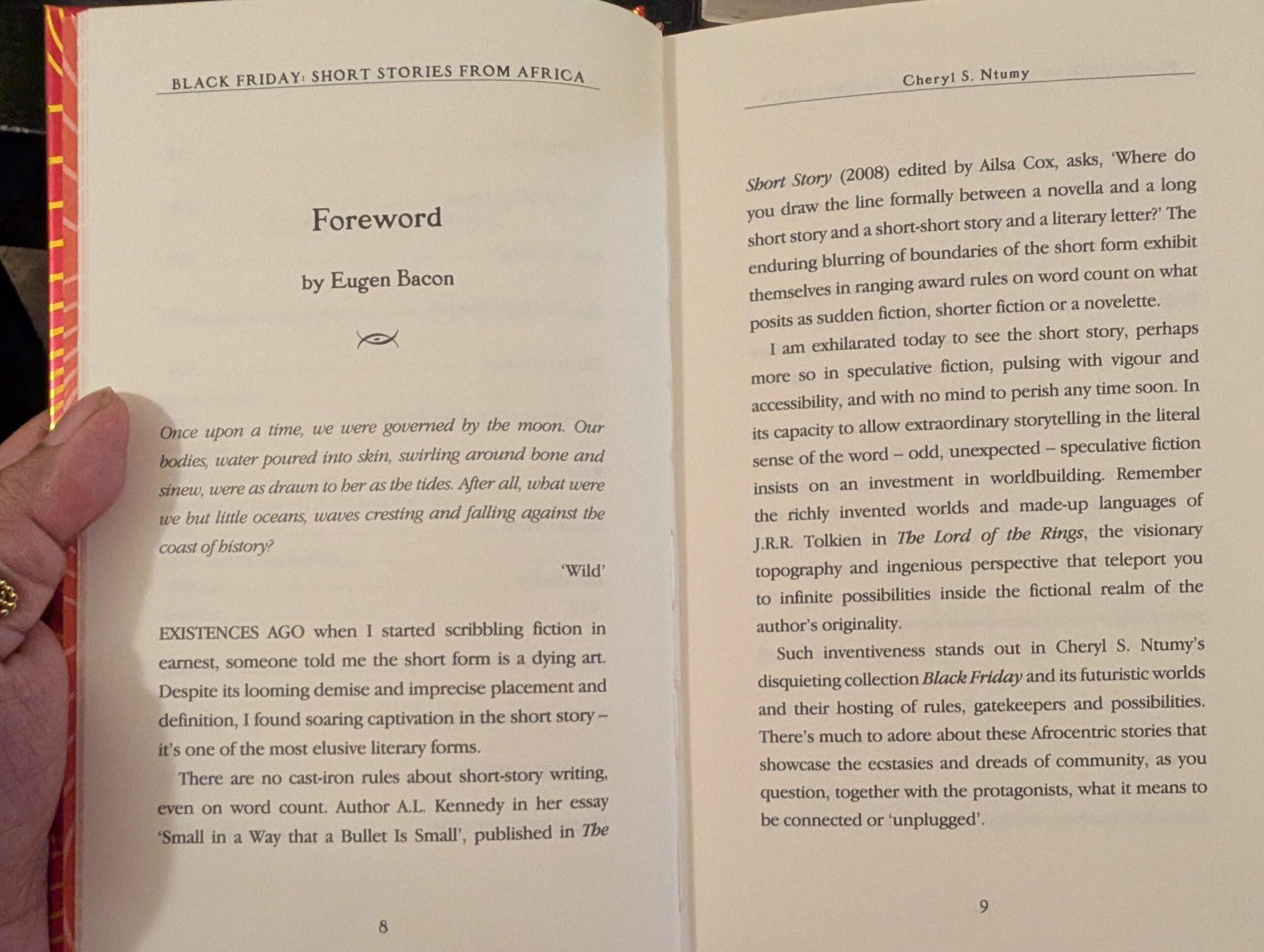
Highlights include “There are no cast-iron rules about short-story writing, even on word count. Author A.L. Kennedy … asks, ‘Where do you draw the line formally between a novella and a long short story and a short-short story and a literary letter?’ The enduring blurring of boundaries of the short form exhibit themselves in ranging award rules on word count on what posits as sudden fiction, shorter fiction or a novelette.
“I am exhilarated today to see the short story, perhaps more so in speculative fiction, pulsing with vigour and accessibility, and with no mind to perish any time soon.”
Doug: Nice!

 Al Singh
 Doug Merrill
 Doreen Sheridan
 Emily Lauer
 John Pitzel
 Lars N. Goldschlager
 Laura Eilers
 Professor X
 Robert Maedgen
 Sylvere Ap Leanan
 The Shire