
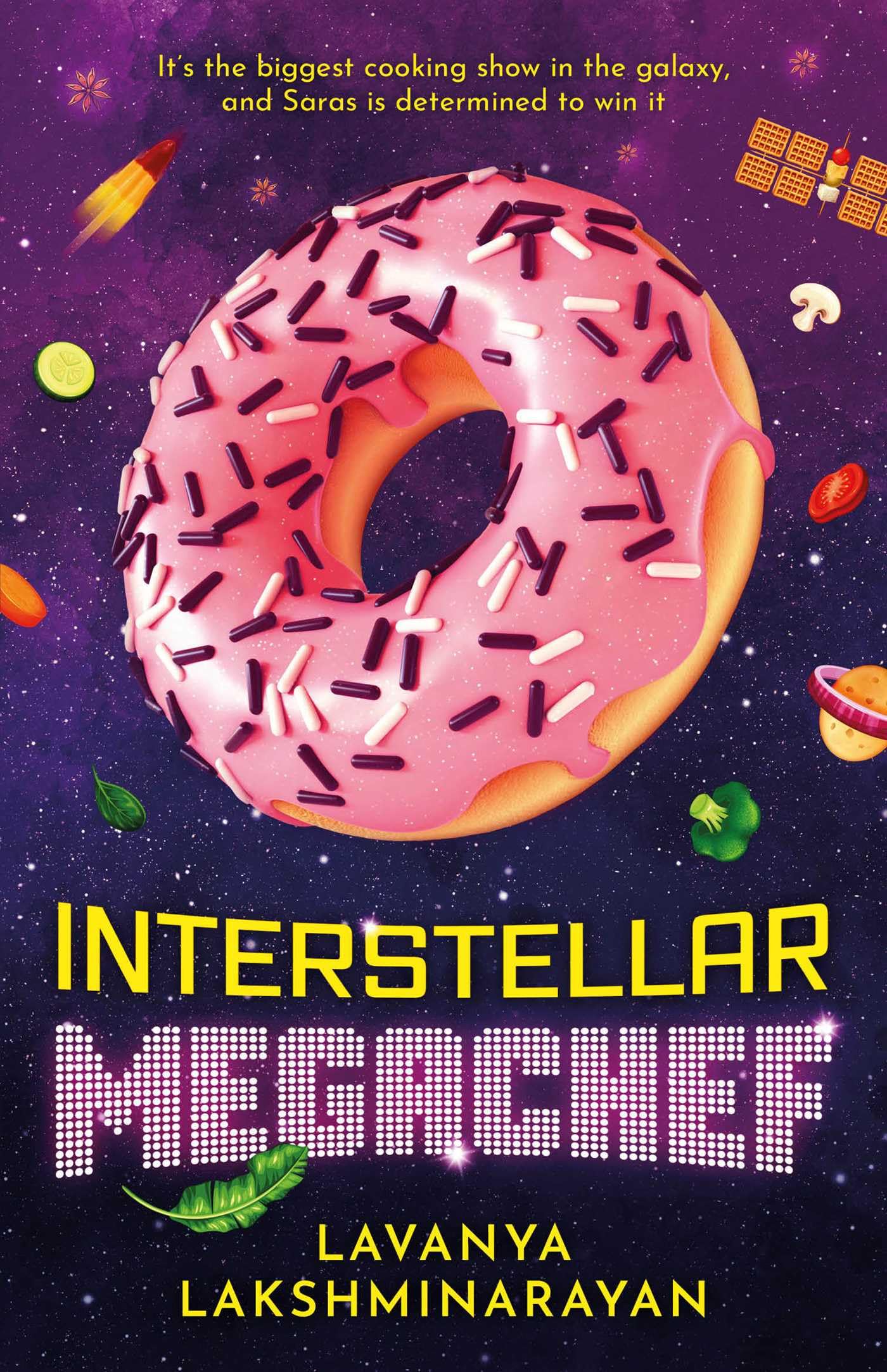
Interstellar Megachef was another 450-page book that I thought held a 250-page story. Often when I have that feeling about a book, I consider what I think should be cut but I usually draw a blank and offer the slightly lame explanation that if I knew where and how to trim novels, I would be a book editor. In this case, though, I have a very specific idea: start the novel about a third of the way down page 193.
It’s not that what has gone before is unnecessary, exactly, it’s just that the awkward meeting between Serenity Ko and Saras Kaveri in a gloomy side-street archway, with Saras on the verge of a breakdown, is where the story really starts. I don’t know if Lakshminarayan’s publisher would have accepted a book that was forty percent shorter; I don’t know if Lakshminarayan’s intended audience enjoyed the backstory more than I did; I don’t know if either author or prospective audience just liked the characters well enough to enjoy simply spending time with them. I do think that attentive readers could have picked up all of the relevant bits of what had gone before, and that figuring it out, rather than having it served up on a platter, would have been part of the fun. I don’t even think that Lakshminarayan would have needed to add much, if any, exposition to add in the details that led up to the fateful meeting.
At any rate, Serenity Ko is brilliant, as Lakshminarayan tells readers numerous times. She’s a sim designer for one of the best organizations on Primus; she’s hard-charging, capable, full of insight and destined for great things. She’s also young, emotionally fragile, very full of herself, and prone to misjudging how her actions will affect people. She’s from a family of exceptional achievers and feels the need to prove herself as one of them, which she does by throwing herself into her work — in an environment that resembles a 2020s video game company — and ignoring her family almost entirely. Her family mostly forgives her, because families often do, and because it serves the plot of the novel. The family is highly placed in Primian society, which is theoretically egalitarian but very much is not in practice.
Saraswati Kaveri is just as brilliant but instead of sims, her field is restaurant cooking. Saras, too, comes from a prominent and powerful family, one of the most powerful on old Earth, as it happens. As Interstellar Megachef opens, she has run away from them, taken on a new identity, presented herself as a refugee on Primus and is dead-set on entering and winning Primus’ top sensation in reality television, Interstellar Megachef. Saras, whose chapters are told in the first person, had endured apprenticeships in demanding and personally toxic kitchens but had managed to win Earth-wide acclaim with her own restaurant without, she says, replicating those conditions. Her family, though, had come calling and said it was time to stop playing around, she had to pull the plug on the venture, make an advantageous marriage, and start pumping out heirs. A particularly nasty relation told her — truthfully or otherwise, neither Saras nor readers can tell — that her whole career had been set up by family influence. So she skipped twenty-one interstellar jumps away and presented herself on Primus as a nobody, but with skills.
Well, a nobody who had previously submitted an application for the Interstellar Megachef show, complete with a holovid shot while there was literal shooting going on around her. I suppose the producers liked that touch, because otherwise Interstellar Megachef would have been a very short book. That’s not entirely fair, but Saras’ improbable success at the outset is emblematic of the way the world bends around Lakshminarayan’s two protagonists. Yes, Saras is set up to fail, which leads to the state she is in on page 193, but her travails are otherwise short, and her main problem is getting over herself and accepting help. (It’s worth mentioning that Saras and Ko meet a couple of times earlier in the book, interact poorly, but are Somehow terribly attracted to each other without either letting on in the slightest.) Ko is even more of a mess, and although both her brother and her grandmother give her thorough dressings down, neither of them is really serious about letting her bear the consequences of her actions. Both their supporting casts and their supposed antagonists are strangely inert when neither is around. It’s as if the non-lead characters are all off on a smoke break somewhere, waiting until either Saras or Ko turns up in a scene to set them in motion again.
Other things broke my willingness to play along with the story just as badly. For example, Primus is coming up on a thousand-year celebration but Lakshminarayan has some of the planet’s top cultural bureaucrats at a loss for what to have as the capstone event just a year from when it is supposed to take place. I don’t know if Lakshminarayan has ever been close to planning a major public event, or even a minor one, but she could at least have asked someone who had, and they would have told her: no way.
And what does the assembled committee come up with? A special episode of Interstellar Megachef! Grafted on to a celebration that is otherwise invisible in the book. Guess who gets to come back after her disastrous initial appearance? Saras, of course! With a side order of Ko, whose latest brainwave is a type of sim that triggers memories sparked by eating, à la the final scene in Ratatouille. Their work together is a direct result of the meeting at what I thought should have been the start of the book. Some of the getting there is fun, some of it is merely inevitable plotting, but of course they end up as finalists on the special episode. Do they win? Do these two who initially can’t stand each other have a sudden passionately public kiss? Do I even have to ask?
There is a bit of a subplot with Earth politics and Saras’ hidden past threatening her new life on Primus, and it is left completely hanging at the end of Interstellar Megachef. Ko’s tasting simulation might be put to nefarious uses, but she denies that will happen, even when sensible people point out what businesses and other large organizations have been known to do. A sequel, Intergalactic Feast, will be published in March 2026. I suppose the plucky chef and her girlfriend will save the universe, or at least some portion of it.
I really wanted to like Interstellar Megachef. From the description, I thought that it might be as wonderfully bonkers as some of Catherynne Valente‘s lighter books, or in the best case something from way out in left field like Light From Uncommon Stars. What I got were characters who were collections of tropes, a plot as predictable as the tides, and structures (how Lakshminarayan addresses history and politics, for example) that strained my belief at nearly every turn. I was excited about the setup, but it turns out the execution was not for me.

 Al Singh
 Doug Merrill
 Doreen Sheridan
 Emily Lauer
 John Pitzel
 Lars N. Goldschlager
 Laura Eilers
 Professor X
 Robert Maedgen
 Sylvere Ap Leanan
 The Shire