In a world of increasing geopolitical cynicism, fueled by the atrocities of the military-industrial complex, a debut geopolitical novel asks: what if war wasn’t a tragedy, but a business model?
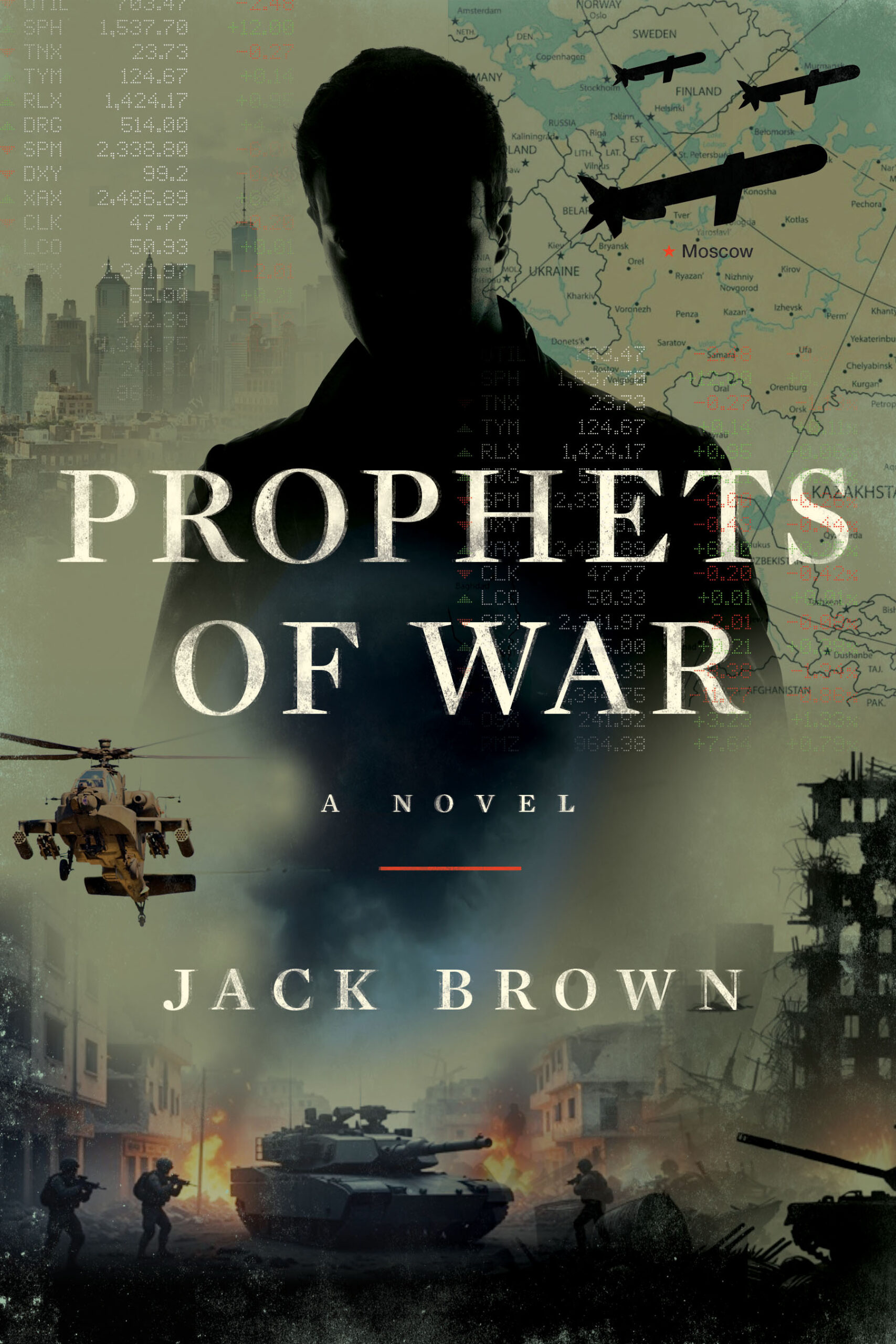 That’s the question that author Jack Brown posits in his high-stakes thriller Prophets of War, as he explores the intersection of ambition, ideology, war and capital. When Alex Morgan*, a rising star in wealth management, stumbles onto a series of cryptic financial clues, he doesn’t just uncover corruption. He unmasks a global conspiracy. For behind the headlines of the war in Ukraine lies something far more chilling: a private empire of shell companies, black-market trades and political operatives who are turning global conflict into personal profit.
The deeper Alex digs, the more terrifying the truth becomes. His own father may be at the center of the scheme. His mentors may be funding both sides of the battlefield. And the woman he trusts the most might be the key to it all — or may represent the final betrayal.
From Caribbean tax havens to Wall Street boardrooms to shadowy Zoom calls between oligarchs and ex-presidents, Prophets of War is a pulse-pounding political thriller that tears into the machinery of modern power. Inspired by real systems, real tactics and real moral failures, it asks a question no one wants answered: what if the next world war is already on the balance sheet?
Read on for an illuminating look at our protagonist, on the cusp of having his entire world turned upside down!
~~~~~~~
Excerpt from Prophets of War by Jack Brown, published by Morgan House Press, 2025. Reprinted with permission from the publisher.
I had it all worked out. My own father had started a business of war that was responsible for Russia’s invasion of Ukraine. His offshore empire fueled the invasion, raking in billions in blood money. The largest war since World War II, and he was profiting from every missile, every death. It was a war that had been set up as an offshore company in the British Virgin Islands.
My dad—the modern-day Adolf Hitler. Unbelievable.
And I was the one who uncovered it.
But let me back up. A few months earlier, I was flying high. I’d just passed my Series 7 exam and started working full-time as a financial advisor. My firm promised partnership—millions of dollars if I kept closing deals. I owned ten apartments across two states. My trajectory was pure vertical.
Until I found out.
It was November in Connecticut. Leaves clung to the last scrapes of orange, the air sharp with pre-winter tension. I climbed the steps to our office building—a converted yellow house with chipped siding. My boss Warren owned the place. For someone managing hundreds of millions, you’d think he could repaint.
“Good morning!” I chirped to the secretary on autopilot. That’d be the only thing I said to her all day.
Inside, I saw Warren was already in. He was in his mid-to-late fifties with a ramrod posture and a nose that drooped at the tip.
Born in Palm Beach. Old money energy. We didn’t do small talk—just business. Today, though, he gave me a weird look like why didn’t you say good morning to me? Maybe because you never do.
I ducked into my office, dropped into my leather chair, and hadn’t even logged in when the manager popped her head in.
“You make your coffee yet?”
Not now. I had a ferocious hangover, and her voice grated in my ear like a buzzing mosquito that I couldn’t swat away.
She was always on me about the coffee. Whatever. Better that than blow. Besides, caffeine and nicotine were part of the job. I reached for a ZYN, tucked it into my lip, and reminded myself: stimulants equal productivity. Caffeine + nicotine = protein. Simple math.
Besides, who the hell is she to tell me how much coffee to drink? Me, a young Master of the Universe. Masters of the Universe don’t put up with crap from anyone. They are the killers. The ones who don’t take no for an answer. The ones who don’t hang up the phone until the client either buys or dies. The ones dressed in three-piece suits, and shirts with cufflinks, and $50,000 gold watches. The ones pulling up to work in a Porsche, or maybe a Mercedes, or a Ferrari.
Well, maybe I wasn’t quite a Master of the Universe yet, but this manager had better realize that I was on my way to being one.
Warren burst through the door.
“Push the emerging market funds today. Every client.” Then he was gone. That fund has sucked for years. Why now?
I logged into the Wall Street Journal. First headline: Dow drops 700 points after inflation report. The market was tanking—a perfect time to pitch clients. Warren loved down years. He’d flip fear into opportunity and walk out of meetings with fresh deposit checks. It was genius.
The next article I saw was about the Russian invasion of Ukraine. I’d been reading about it almost every day. Battle tactics, negotiation strategies, and major turning points of the war flooded my mind. Something about great men and great wars fascinated me. Winning at war and in the stock market require the same thing—a bulletproof strategy.
I checked my email. My inbox revealed a flood of emails containing client questions and market reports. One caught my eye. It had been sent by one of the industry newsletters I subscribed to. The subject read: Foreign Sanctions & Offshore Risk—BVI Updates.
BVI. Tortola. My second home.
My grandfather started going down in the sixties—before electricity even hit the island. Our family had been going back ever since. My sister lived there now.
I clicked on the newsletter without thinking, half expecting a dry compliance update about tax regulations. Instead, I came across an article that sent a chill running through me. Money was flowing from Russian oligarchs and other wealthy investors through anonymous shell companies, many tied to a single offshore entity that had exploded in value since the war in Ukraine had begun.
That money was funding the war.
I scrolled down, scanning names, company structures, bank transactions. At first, none of it meant much to me. And then I saw the shell company that had exploded in value. The firm was registered in Tortola. And the address was familiar.
My stomach tightened.
I skimmed over the names; one caught my eye: Nikolai Orlov. An oligarch with deep Kremlin ties, sanctioned by the UK the previous month. His money was flowing straight through Tortola.
It wasn’t direct transfers. Instead, the money was laundered through a web of holding companies, funneling millions. The transactions were legal-looking enough, but the destination was the same: the Russian war machine.
I exhaled, staring at the screen, fingers frozen above my keyboard, just a single question hammering relentlessly in my head: Could people I know in Tortola be involved in this?
No, no way. That would be crazy.
I forced myself to close the article. Took a chug of coffee. Then another, trying to steady myself. I reopened the article and studied the address. Road Town. Just minutes from where my sister lived.
And then—I remembered.
A few months earlier, my father had casually asked me, “What do you think about the Ukraine war?” We rarely talked politics. I shrugged it off.
But now I remembered something else—years ago, Dad had once joked, “If you’re gonna start a business of war, start it in Tortola.” We laughed. But this wasn’t a joke anymore.
I closed the article. My gut felt like it had swallowed an anchor.
~~~~~~~
From Prophets Of War by Jack Brown. Copyright © 2025 by the author and reprinted by permission.
Prophets Of War by Jack Brown was published September 15 2025 by Morgan House Press and is available from all good booksellers.

 Al Singh
 Doug Merrill
 Doreen Sheridan
 Emily Lauer
 John Pitzel
 Lars N. Goldschlager
 Laura Eilers
 Professor X
 Robert Maedgen
 Sylvere Ap Leanan
 The Shire