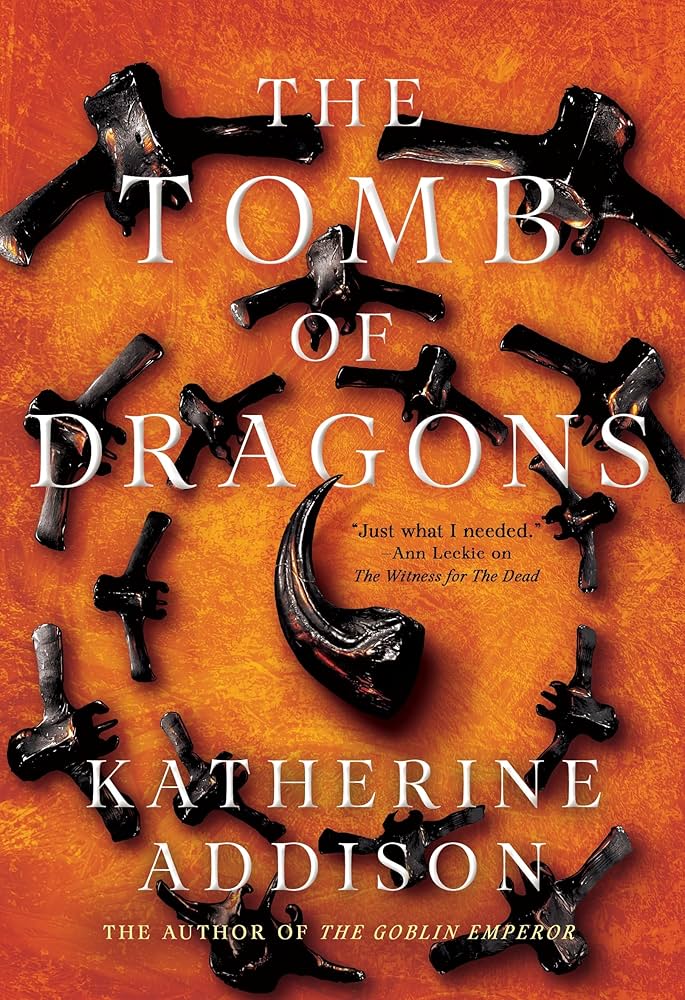
The Tomb of Dragons is that rare third book of a trilogy that makes me view the first two books very differently. All three of the “Cemeteries of Amalo” share a world and time with Addison’s classic, The Goblin Emperor. The first-person narrator of the trilogy is Thara Celehar, a cleric of Ulis and a Witness for the Dead, someone who can reach the spirits of the departing newly dead and communicate with them in a limited fashion. Such Witnesses give true testimony about the thoughts or wishes of the dead so as to answer questions about their death, or to resolve other disputes. Their abilities also enable them to do things like still undead ghouls. In both The Witness for the Dead and The Grief of Stones Celehar has put his supernatural skills in the service of the people around him, and the communities he is a part of.
His last act of service, though, cost him dearly. He can no longer witness, although this is not widely known. In The Grief of Stones, he had taken on an apprentice, Velhiro Tomasaran. Now she must assume the full office much sooner than anyone had anticipated. She came to be a cleric later in life, and she is not what most people of Amalo expect. Celehar is unstinting in support, and at least at the beginning of her service he may believe in Velhiro more than she herself does. A short novel from her perspective would be very interesting, and that’s true of many of the other characters who pass through the pages of The Tomb of Dragons. Celehar’s friend from the opera Iäna Pel-Thenhior would be an urbane counterpart to the dedicated but also self-doubting Celehar; a book from his point of view would show a lively and creative city, and his work balancing art with the cheerful mercenary approach necessary to keep an opera company in business. Like the end of The Goblin Emperor, the end of Celehar’s trilogy leaves open how many more stories Addison could tell.
The one that she does tell takes readers in and out of Amalo. Celehar may lack his supernatural connection, but he can still undertake tasks suited to his talents. One task that’s both poignant and amusing, and potentially troubling, is to help a particular parish get its paperwork in order. The parish cannot conduct new burials because the oldest remains in its tombs cannot be relocated because the paperwork has backed up. That does not convey the scale of the problem: A previous prelate did not file or forward anything for a great many years, and now several rooms are quite literally filled with papers that no one knows what to do with. Any one of them could be vitally important, and they all have to be evaluated in some way. As Celehar takes on this task, enlisting a few subordinates to assist, it becomes apparent that the papers might conceal deeper secrets, and not just in their contents.
The task that lends the book its title is more sinister. A mine that provided considerable wealth to the empire may have been built on the basis of a terrible crime. Celehar is compelled to go to the mine by people who think he still has his supernatural abilities, and who don’t much care about what happens to him anyway. There are many ways that the mine could become his tomb as well. It doesn’t, of course, but the resolution of competing claims for justice changes him deeply.
As I read through the aftermath of these changes, I saw more clearly how badly Celehar had been broken by events that took place before the beginning of the trilogy. The hurt had been there all along, but I had seen it as part of his character. Through the events in The Tomb of Dragons, I began to see what an undamaged, or at least a partly healed, Celehar might be like. Each of the books told exciting and interesting stories, but the subtle and implied revelation of Celehar’s possible future is a much greater achievement, built from the beginning and earned by all the tribulations in between. It’s a fine ending, and one that made me see the other books in a different light.

 Al Singh
 Doug Merrill
 Doreen Sheridan
 Emily Lauer
 John Pitzel
 Lars N. Goldschlager
 Laura Eilers
 Professor X
 Robert Maedgen
 Sylvere Ap Leanan
 The Shire