Hello, dear readers! Today I’m excited to bring to you a fascinating examination of power and corruption, with an excerpt from the paperback reissue of Ed Simon’s provocative, persuasive and just downright mesmerizing Devil’s Contract: The History Of The Faustian Bargain.
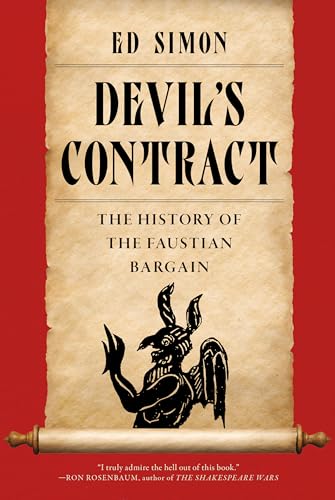 To quote the press materials: “From ancient times to the modern world, the idea of the Faustian bargain—the exchange of one’s soul in return for untold riches and power—has exerted a magnetic pull upon our collective imaginations.
“Scholar Ed Simon takes us on a historical tour of the Faustian bargain, from the Bible to blues, and illustrates how the impulse to sacrifice our principles in exchange for power is present in all kinds of social ills, from colonialism to nuclear warfare, from social media to climate change to AI, and beyond. In doing so, Simon conveys just how much the Faustian bargain shows us about power and evil . . . and ourselves.”
The excerpt we have for you today discusses a fascinating, and definitely unorthodox, examination of Jesus’ temptation in the desert. Showcasing Mr Simon’s wide range of knowledge, the excerpt begins with a discussion of the art world, before going in for the kill with a thoughtful and thought-provoking discussion of Christian scripture.
Read on to be just as dazzled as I was by this smart and stylishly written bestseller!
~~~~~~~
Sotheby’s, the venerable British auction house, has its American headquarters on York Avenue along the edge of the Upper East Side, situated halfway between the comparative calm of Carl Schurz Park and the cacophony of Memorial Sloan Kettering hospital. On January 27th, 2023 a wealthy art patron, as is such a person’s wont, would have traded York Avenue’s ambulance wails and honking taxis for the relative silence of Sotheby’s glass, modernist monolith, and successfully bid forty thousand dollars—a steal—for a marginal painting by a marginal artist that nonetheless conveys the strangeness of its biblical subject with quiet sublimity.
Lodewijk Toeput was born in Flanders, but spent his life in Italy, where he worked under the name “il Pozzoserrato,” so that the sixteenth-century painter’s work is a delightful fusion of two different Renaissance styles, a combination of the epic scope of Florence with the human intimacy of Amsterdam. Il Pozzoserrato’s Landscape with Scenes from the Life of Christ, the painting auctioned in lot 478 on that day, was most likely painted in Italy sometime in the last decade of the sixteenth century. Borrowing the hazy blue sfumato of his Italian antecedents and his fellow Netherlandish painters (especially Brueghel), and Toeput imagines a vast rustic tableau of massive primeval trees and violently gashed valleys, a first-century Judea that appears more as if a particularly lush Tuscany. A triumphal Roman arch, in ruins and covered in encroaching ivy, is admired by several small figures toward the right of the composition. In the grey-tinged lunar-blue background there are the towers of a fantastic city. And there, toward the bottom center of the painting and again atop a high peak of jagged rocks depicted on the far left are two instances of Toeput’s titular subject.
In the valley below, a haloed Son of Man commands Thomas to probe the side-wound of his resurrected body, while on the peak above Christ stands with the Devil, the third of the temptations presented to the Messiah during his forty-day-long vigil in the wilderness.1 All the figures, despite their supernatural import, are dwarfed by the vista. They’re easy to overlook at first. Christ appears as the man that he was, but then so does the Devil—a prosaic, forgettable, normal figure.
=======
From the Flemish miniaturist Simon Bening’s sixteenth-century representation of the Devil as a bird-footed, becloaked bestial monstrosity to the French lithographer Gustave Doré’s iconic hard-bodied, bat-winged fallen angel of the nineteenth century, Satan is oft-depicted as something bizarre. Toeput was hardly the first artist to imagine the Devil coming in the guise of a man; there is nothing revolutionary in Landscape with Scenes from the Life of Christ, but that sartorial decision does result in a composition that underscores the human nature of Christ’s temptations. Not that Toeput or any other artist who has taken the temptations of Christ as a subject has much from the biblical narrative to draw upon.2
As recounted in Matthew, which is my preferred version because it evidences a logic of ever more consequential challenges, Satan appears to the weary and worn Christ and commands him to transform the stones of the desert into bread, which the Messiah refuses to do, answering that “Man does not live by bread alone.” Then the Prince of Lies takes Christ to the very parapet of the Temple in Jerusalem, imploring him to jump, the presumption being that a chorus of angels bearing Him to the ground would prove that Jesus is indeed who He claims to be. To such a challenge, Christ tells the Devil “Thou shalt not tempt the Lord thy God.” Finally, Lucifer brings Christ to the top of a tall peak in the desert, and shows Him all of the kingdoms of the world; if Christ will only supplicate Satan, then the Devil will offer all to Jesus. “Get away Satan!” is Christ’s response, and with that the Son of Man has proven Himself true and faithful when confronted by every temptation presented by the Prince of Perdition. This, then, is the rough scaffold of the tale; the gospels aren’t consistent in the ordering of the temptations (the second and third are switched in Luke, for example).
That he rejected such offers makes all the difference; both the crucifixion and the resurrection would have been impossible without the passing of this test in the desert. Though the ministers and theologians may blanch at the identification of this story as a variation on the Faust trope, they’ll be positively apoplectic when I claim that the encounter in the Judean wilderness is the most important moment in the entirety of the New Testament, not because it depicts Christ as winning this contest, but because it implies an alternative where Jesus might have succumbed. What logically follows is an entire gospel of power derived from asking what it would mean for God to sign a contract with the Devil.
Part of the innate mystery of scripture is the lack of detail, so different from what our contemporary novelistic imaginations demand. Satan isn’t described at all in any of the synoptic gospels—Mark doesn’t even identify him as such, only cryptically referring to the figure as the tempter.3 No horns or wings, no cloven hooves or forked tail. Naturally that absence of specificity has allowed for a multitude of artistic interpretations, from the animalistic creature in Bening to the Byronic hero of Doré, but despite Toeput’s liberties (the Judean Desert doesn’t look like Flanders, for example), there is something all the more unsettling in the Devil appearing in the guise of a man. Christ sits among the jagged rocks of the Judean Desert, a place of disorienting jutting precipices and deep caverns gashed into the rough and broken flesh of the earth, of scalding noonday sun and freezing midnight. His only companions are the locusts and scorpions, the spiders and the centipedes; Christ’s dark weathered skin is sun-blistered, his nut-brown face burnt by the wind and the heat—sand cuts like a prayer into the dried surfaces of his russet eyes, dirt clings like a parable to his swollen grey hands, small cuts cover his bruised arms and legs like the scratched words of a psalm. And what of Satan, what does he look like? Not monster, but a man—maybe a monk or mystic, possibly identical in appearance to the Messiah. Same short-shorn black curly hair, same red-streaked beard, equal in short stature, missing matching teeth, clothed in identical rough, woolen tunics.
For forty days before the adversary would appear, Christ lives a scripture of pebbles, stones, and rocks, a Bible of silt, gravel, and dirt. A true Bible of this fallen world. This is the scene into which Ha Satan—Hebrew for “The Adversary”—does announce himself to the Son of God. Crucially, this test of wills between God and the Devil is itself a form of disputation; the two are involved entirely in source-quoting material from the Hebrew Scriptures, a battle not of supernatural powers as with Simon and Peter, but of exegetical acumen. Through the entire story, there is the question of if the Devil knows exactly who it is that he’s tempting. For that matter, there is the conundrum of whether Jesus really knows who He is.4
Connecting Christ’s biblical temptation in the desert to the Faust legend is a controversial assertion—no doubt the ministers and theologians will be annoyed that I’ve done so. Yet what do Matthew, Mark, and Luke recount other than a failed attempt on the part of the Devil to enact a Faustian negotiation, a contract which Christ completely rejects? After all, Satan has offered certain gifts in exchange for Christ’s fealty.
This is the story of a failed Faustian bargain, yet a Faustian bargain all the same. What a bizarre story then, the tale of the Devil commanding God to bow down. What exactly does it mean for the mere creature to entice the Creator to transgress? There is, to be sure, a certain melancholy to the idea, where even He who embodies ultimate Goodness can be tempted by evil. There are shades of this anxiety in the Hebrew Scriptures, where in that immaculate book of Job the Great Adversary who is Satan tricks the Lord into punishing a pious man. Yet in the tale of Jesus’s temptation in the desert, there is something else, a sense of God’s humanity, for Christ incarnate is equally man as He is God, so in all our failings, all of our possibilities of temptation, we have a deity who can share in our own fallibility and fallenness.5 So what exactly does it even mean for Satan to tempt God?
Whether or not Jesus thought himself to be God is an issue of faith. That the authors of Matthew, Mark, and Luke didn’t think that Jesus was God—for the first two were clearly religious Jews for whom such a concept would be absurdity—is obvious from reading the texts themselves.6 Why would Satan offer the world to the very being who created it? Notable that of the four gospels of the New Testament only the otherwise metaphysically inclined John doesn’t include the story of the temptation, for in that work it’s clear that the author views Christ as not only the Messiah, but as an incarnation of God.
Perhaps by that point the Devil knew better. Yet the synoptic gospels are canonical, and in the bulk of the Christian traditions which receive them as inspired there is a creedal belief in Christ being God, so the story of the temptation can’t but be read as a Faustian bargain presented to the Lord. This clearly presents certain philosophical issues. That Satan believed he was capable of successfully tempting God is important, but that he could have succeeded is crucial. Christianity’s scandalous paradox of absurdity always has been, and always will be, Christ’s being wholly human and entirely God at the same time, and since a man could be ensnared by the temptations offered by Satan, it would follow that Jesus must have been prey to this possibility.
“The temptation of Christ was harder, unspeakably harder, than the temptation of Adam,” argued the Lutheran theologian Dietrich Bonhoeffer during a lecture at the University of Berlin in 1932, delivered as the Weimar Republic was collapsing and the Third Reich, which would eventually execute the radical minister, was coming into power. “Adam carried nothing in himself which could have given the tempter a claim and power over him. But Christ bore in himself the whole burden of flesh, under the curse, under condemnation; and yet his temptation was henceforth to bring help and salvation to all flesh.” When the Devil tempted Christ to sell him His soul—was that a prayer of a sort?—far more was in balance than merely a human’s soul, but rather humanity’s soul.
Christians believe that God and man are unified within the person of Christ, so that the temptation of Jesus in the desert becomes the crescendo of the cosmic drama, where literally everything is at stake. And yet there is a strange dramatic irony in the story, for what use is telling God that He can acquire the very world which He crafted? If we’re to suspend our disbelief and pretend that Christ is really God, then it must be admitted that Jesus clearly could turn stones to bread, safely propel Himself from the pinnacle of the Temple, and easily leash king and emperor. What use is offering anything to an omnipotent being?
The nature of temptation wasn’t literal so much as it was intellectual; within this Faustian bargain, Christ and Satan were arguing over the nature of power. This was a philosophical debate, a hermeneutic battle, an exegetical temptation. The entire point is that Satan knows that Christ can perform those miracles, but that to compel Him to fulfill those requests he’d force God to admit His naked, cynical, authoritarian understanding of power’s exercise. Christ wins this debate—he abrogates any Faustian contract—by refusing to exercise His power.
~~~~~~~
From Devil’s Contract: The History of the Faustian Bargain. Used with permission of the publisher, Melville House Publishing. Copyright © 2024 by Ed Simon.
Devil’s Contract by Ed Simon was reissued in paperback yesterday September 16 2025 by Melville House and is available from all good booksellers, including

 Al Singh
 Doug Merrill
 Doreen Sheridan
 Emily Lauer
 John Pitzel
 Lars N. Goldschlager
 Laura Eilers
 Professor X
 Robert Maedgen
 Sylvere Ap Leanan
 The Shire