The fourth, and presumably final, Lady Astronauts of Mars novel begins with an echo of the opening of the first. “Do you remember where you were when the stars came out? I was with my husband, on Mars.” (p. 14) It’s 1970, and there hasn’t been a clear night sky on Earth since early March 1952, when a meteor the size of the dinosaur-killer plowed into Chesapeake Bay, changing everything.
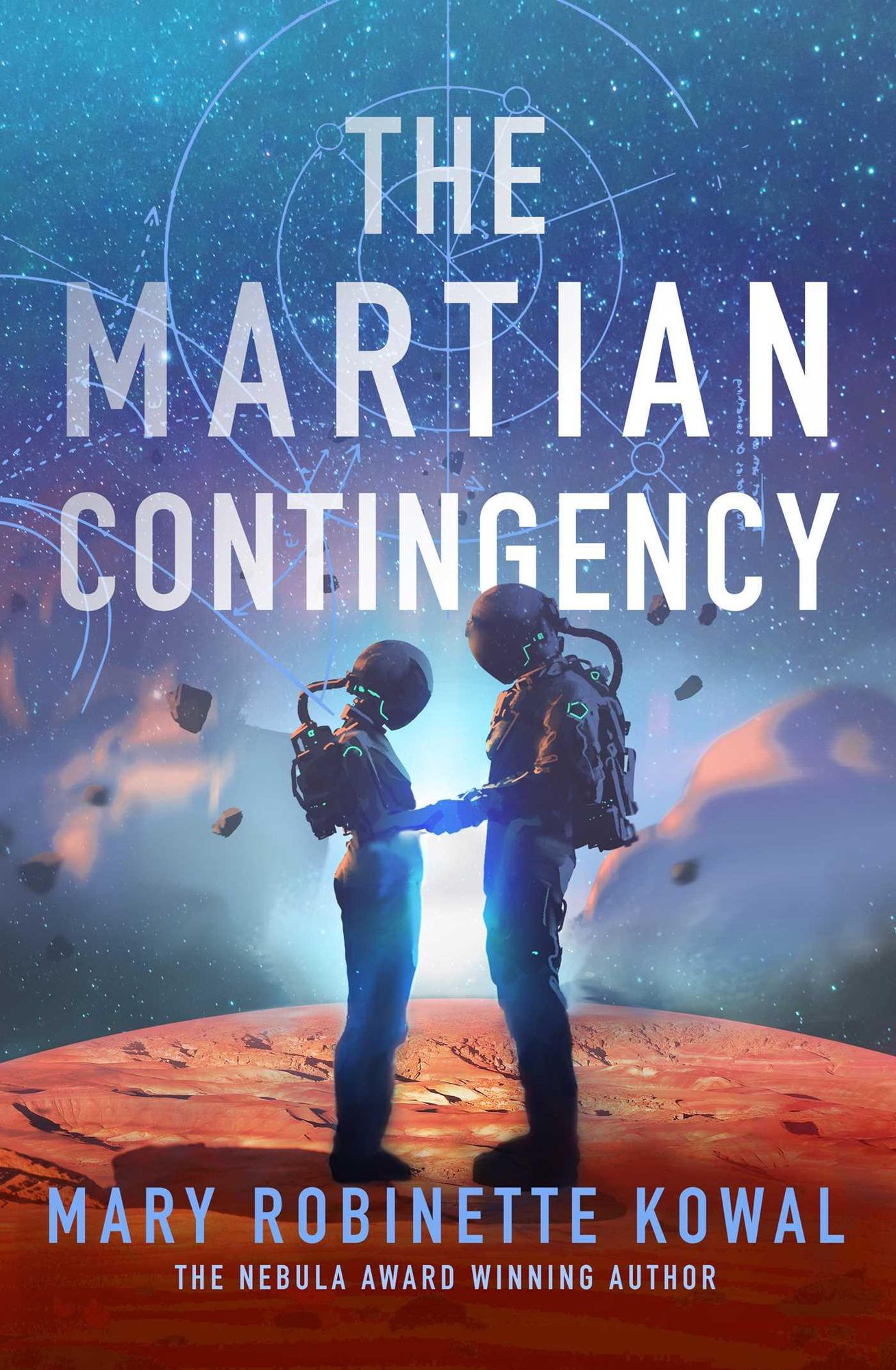
After one book with Nicole Wargin as first-person narrator, Kowal brings Elma York, the most famous Lady Astronaut, back to the hot seat in The Martian Contingency. Besides, Nicole is busy; she’s president of the United States. Bradbury Base is established on Mars, and Elma is part of the expedition that will expand the base with a second dome and a greenhouse plus additional scientific and work modules. The members of the second expedition are also expected to become permanent residents of the red planet. As happy and amazed as she is to be on Mars with her husband Nathaniel, she’s apprehensive about her imminent change from spaceship pilot to deputy commander of the mission.
While the people on Mars have escaped Earth’s gravity, they have not escaped the gravity of Earth’s situation. That means the expedition needs to keep building support on Earth for beginning the work of transplanting humanity. And that means
[t]he bean counters back on Earth had wanted me—no, they’d wanted the famous Lady Astronaut of Mars in a visible command position to lend credibility to the mission. That should have come from the actual mission commander, but Leonard Flannery was Black. He was also eminently more qualified to be mission commander than I was. He’d landed on the planet on the first mission. I hadn’t. But I was very good at being a pretty face for publicity.
Thank God we were past the days where we had to avoid mentioning that I was Jewish. Mostly past. (p. 15)
Throughout the series, Kowal has hammered home the inherent dangers of space, showing how much care has to be taken all the time just to stay alive in an unrelentingly hostile environment. Mars is not much less hostile, but life on a planet is different, and from the beginning of the book she brings those differences to life, her characters mixing wonder with the need to remain vigilant.
Care:
The landing pad was the same familiar shape as the one on the Moon, but a soft salmon instead of lunar gray. Everything felt different from training. I’d experienced spacesuits and Moon suits, both were stiffer than a Mars suit. Training on Earth, it was heavier. … Training on the Moon, you couldn’t hear the whisper of wind outside your helmet.
Wind. Just wind. Not the sound of a spacesuit failing. (p. 15)
And wonder:
“Elma, come look.” Nathaniel stood between the [landing ship] Esther and the arched doorway into the base. “The Goddard is transiting.”
I didn’t run, because that’s a good way to fall and damage your suit. But I looked up as I walked to him. Across the dancing backdrop of the evening sky, the clear bright light of the Goddard, the ship that had brought us here, traced an arc across the heavens.
“Oh—” My breath caught at the sight of an evening star. We weren’t displaced enough in the galactic disc to make a difference, so we had the same stars and the same constellations. Except for one significant difference. “It’s Earth.”
Small and the palest blue, if you thought about the color blue while looking at it, our home planet sat low in the horizon to the west where the sun had set. (p. 16)
Right down to the smelly details:
… I inhaled and stopped. A scent of sulfur with a chalky sweet overtone filled the airlock, in a combination unlike anything I’d smelled before. On the Moon, when you come back in, you get a scent of gunpowder and old campfire that was the weird but unmistakable smell of lunar regolith.
This was Mars.
This was what Mars smelled like. I let go of the handle and turned back to Nathaniel, waiting for the moment when he had his helmet off. The second glove was clear. Grinning, I bounded over to him, so that I was directly in front of him when he removed his helmet.
“Breathe in.” I bounced on my toes.
His nose wrinkled. “I know. It smells like rotten eggs.”
“That’s Mars.” I grinned at him. “The folks who got to go down to the surface during the First Mars Expedition said it smelled like rotten eggs. That’s Mars. We’re smelling Mars.”
“You are very excited about rotten eggs.”
I leaned forward and kissed him. “I am.” I kissed him again. “It’s a whole new planet.” (p. 18)
It may be a whole new planet, but humans have brought many of their old problems with them, as if learning to live in an environment that evolution had in no way prepared them for were not challenge enough.
The Martian Contingency is not a novel of whether the expedition as a whole will survive; like the other books in the series it is a novel of how the people in the story will overcome the physical and human obstacles. The characters are also very aware that they are setting examples, precedents for future human settlement on Mars. If they get things right the first time, they will make the future jobs and lives of the people who come after them that much easier. Any mistakes they make will have to be overcome, slowing down the urgent needs of moving people to Mars.
There are plenty of questions, and plenty of things that can and do go wrong. Early on, Elma notices some unusual patching on one wall of the base. Once she starts looking, she finds several other repairs and modifications that are not noted in the maintenance logs. Worse, she realizes that fellow astronauts from the First Expedition are hiding something from her. It’s no minor matter either: undocumented changes to the base could become sources of catastrophic failure, and nobody would even know what or where they were. Elma’s comrades from her previous mission to Mars should be her most trusted colleagues on the current expedition, the people she can count on more than any others. What are they hiding, and why?
Other questions may seem more esoteric, but are also important for starting a society. What does living on another planet mean for practicing religions that originated on earth and whose most important days are tied to earth’s calendar? When does Easter happen on Mars? Passover? Ramadan?
Sometimes the problems are interrelated. The expedition loses a supply drop, and suddenly all the worries about sabotage return. Can they make do without what was lost? Will there be more losses, possibly enough to end the mission? One of the items in that shipment was a large share of the planned supply of condoms. Most of the Mars expedition consists of married couples, so the planners were well aware that there would be plenty of sex among the members. But questions of pregnancy, birth and child-rearing on Mars had barely been asked, and they were nowhere near being answered. As a character with medical authority says, “I need to be clear about this. Don’t take any chances. We are planning to have children on Mars but are a good decade of research away from human conception here. Do any of you want your wives to be the subject of science papers on fetal development under Martian gravity? No? I didn’t think so.” (p. 176)
Of course there’s a pregnancy scare later on. Its resolution involves religious tenets, national pride (the first human born on Mars came from *our* country!), individual autonomy, duties to the mission, the importance of women in positions of authority, and more. Nothing about living on a new planet is going to be simple, not even the barest facts of life.
But in The Martian Contingency enough problems are solved, enough crises managed and averted, enough accommodations reached among the people, enough new traditions are created and old ones adapted that by the book’s end, it’s clear that this habitation is there to stay. There are many more stories that could be told, but this story, the story of the Lady Astronauts and how some of them came to live on Mars, has been brought to a satisfying conclusion.

 Al Singh
 Doug Merrill
 Doreen Sheridan
 Emily Lauer
 John Pitzel
 Lars N. Goldschlager
 Laura Eilers
 Professor X
 Robert Maedgen
 Sylvere Ap Leanan
 The Shire