Hello, dear readers! As promised in my last Tantalizing Tales column, today we have an excerpt of the recently published examination of the life and works of the famed English poet and artist William Blake, and how relevant the lessons we can learn from those still are today.
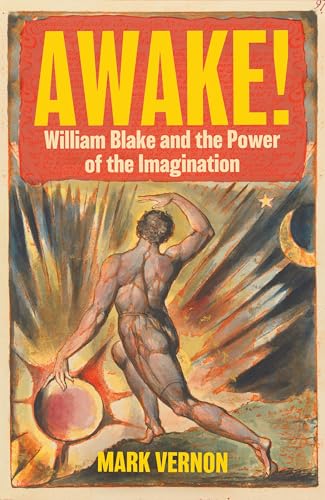 Philosopher and psychotherapist Mark Vernon’s new book Awake! William Blake And The Power Of The Imagination meditates on his subject to come to what I felt were several surprising conclusions. While I certainly agreed with the author regarding the logical fallacies of suggested medical diagnoses to explain away Blake’s visions, I was less convinced by arguments which seemed to turn on the dismissal of words commonly associated with left-wing causes (e.g. progressivism, empathy.) There’s no denying, however, the lasting impact that Blake continues to have on the popular discourse. He may have been dead now for 200 years, but his legacy in poetry, art and thought is ongoing, and may be especially relevant for the turbulent times in which we find ourselves today.
Mr Vernon chooses to take Blake literally in this exploration of his works and life, interpreting his visions of angels as meaningful encounters with the divine. Like us, Blake “lived in a tumultuous era of war, discontent, rapid technological change, and human estrangement from nature. He exposed the dark sides of political fervour and social moralising, while unashamedly celebrating love and liberty. But he also conversed with prophets and angels, and was powerfully, if unconventionally, religious. If we take this seriously[,] then Blake can help us to unlock the transformative power of imagination.”
Read on for a particularly absorbing passage on Blake’s mythological characters and verse, especially as they relate to those of us in the USA and to those of us who love our Marvel movies!
~~~~~~~
His voice grew stronger and he gained confidence with his methods. He became more able to use his art to uncover the shifts of consciousness that drive events and thereby educate the attentive reader. Insight emerges from the resonances that echo across his lines and the vigorous scenes that he wraps around the text on the page. The poems are meant to be provocative, to re-enchant. They challenge a reader, thereby illuminating the issues within a crisis without attempting neatly to resolve them, as does a cool analysis that flatters the reader with an impression of rational clarity. The invitation is to contend with the uncertainty and await the unexpected. Unlearn and reimagine: that’s the way something genuinely novel appears.
Consider his poem, America a Prophecy. It reflects actual events and references historical figures, including George Washington and Thomas Paine; Blake composes speeches as if delivered by key players and presents the twists and turns of the armed struggle. But his goal is not to be factual. Rebellion enlists contraries—violence to secure peace, timeless principles to inspire change, dispute to foster solidarity. But might that energy secure Eternal Delight as well as political progress, glimpses of the higher possibilities Blake thought so key? A distant coloniser, George III, was forcefully ejected for sure. But might the inner life of the Patriots be refashioned, too: the soul decolonised of cultural assumptions? Revolution initiates social change but can it welcome the transcendent?
The poem marks a pivotal moment in the way Blake advanced the asking of such questions. He had previously experimented with fairytale to delve into the anxieties of a single human person, in The Book of Thel, and then brutal experience to explore another’s hopes, in Visions of the Daughters of Albion. However, in America and the works that were to follow, he adds a further form, giving a central place to characters who are collective. They personify transpersonal forces that powerfully influence groups of people as well as individuals. Calling them the Eternals or Zoas, from the Greek for “life” in the sense of life-force, Blake seeks to study them in their own right. This is a way of understanding the energies that seize whole societies, leaving the individuals within them clashing over feelings of disorientation and elation, division and unity.
The Eternals with their forceful verve can be thought of as heroes, in the modern and ancient senses. Today, heroes are energetic individuals who are inspiring because of their commitment to what is good; they will go to the point of sacrificing all for it. Heroes also tend to be known for one virtue or ability—courage perhaps or love—and Blake’s Eternals similarly stand for specific qualities: reason, feeling, energy, imagination. To that he adds the ancient notion of the hero, which brings an enchanted dimension into the frame. For the Greeks of Homer and Plato, a hero is a being who is half-human, half-divine—one who inhabits the regions in between the mortal and immortal, the finite and the infinite. They are powerful, so it is wise to fear as well as honour them, and their actions can be destructive as well as creative. A good outcome is more likely when the Eternals are in touch with the divine. They then work together, united, and reveal transcendent, transformative possibilities. Conversely, when they are not in touch with the divine, they become confused, as likely to wreak havoc as harmony amongst themselves and us. Another similarity with the ancient hero is that Blake’s Eternals have qualities of poetic genius, meaning they manifest imperatives beyond themselves and the immediate circumstances. They can inspire humans, who may or may not be conscious of being in touch with them.
The Eternals can be said to be rather like modern-day superheroes, in fact. When Blake references Urizen, Los, Luvah, Rintrah, Palamabron, Rahab, Tirzah and others bear in mind Superman, the Mighty Thor, Wonder Woman or the X-Men. The association is surprisingly helpful. (That said, the recent Marvel film entitled Eternals, which was apparently named in direct homage to Blake, treats the superheroes as helpers of humankind whereas, as we will see, Blake’s Eternals have a more ambivalent effect on their mortal counterparts.)
Blake is using the mythology to invite us into the insights he gained by clairvoyance, so reading about these characters is another way of cultivating the wider perception he thought invaluable. He is inviting us to contemplate the type of stories that might enable us to become sensitised to the spirits that surround and can invade us: to be alerted to the presence of that which we cannot wholly comprehend, and so not remain unconscious of and passive towards these forceful aspects at play. Myth performs this awakening by inviting the reader to embrace the fictitious world conveyed in the narrative, at once familiar and strange, thereby learning intuitively to relate to cosmic currents and energies. Blake is clear that figures like Urizen and Los are not straightforwardly real entities; he never refers to them outside the context of a poem. But they are imaginative entities that make sense within the perspective of the poem, thereby capturing and conveying truths. They come from in-between spaces to speak to us and a wise innocence can hear them.
Blake’s prophecies are therefore not about passing moral judgement so much as detecting the structure and features of the present. They are also revelatory because they address the whole person, not only the thinking mind, thereby changing how we see, what we feel, our relationship to what’s happening, and our involvement with it. Blake believed that raising the subliminal to conscious awareness is likely to be genuinely transformative. As he put it: true revolution liberates because it focuses on Mental Fight, not literal war—warfare itself being energy Enslav’d.80 The inner is always crucial to the prophet.
~~~~~~~
From Awake!: William Blake And The Power Of The Imagination by Mark Vernon. Copyright © 2025 by the author and reprinted by permission.
Awake!: William Blake And The Power Of The Imagination by Mark Vernon was published September 1 2025 by Hurst & Co and is available from all good booksellers, including

 Al Singh
 Doug Merrill
 Doreen Sheridan
 Emily Lauer
 John Pitzel
 Lars N. Goldschlager
 Laura Eilers
 Professor X
 Robert Maedgen
 Sylvere Ap Leanan
 The Shire