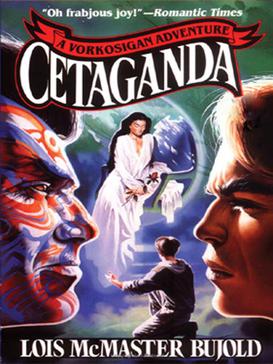
In Cetaganda Miles Vorkosigan, who is all of 22 years old, is sent to represent his home world of Barrayar at the funeral of the Cetagandan Dowager Empress. Accompanying him is his cousin Ivan Vorpatril, who is not much older. Cetaganda possesses a sprawling empire, by the terms of the Vorkosigan series, “eight developed planets and an equal fringe of allied and puppet dependencies.” (3) In fact, Barrayar had been one of those Cetagandan dependencies with the time of occupation and the successful rebellion both well within living memory. With that in mind, I found it odd from the beginning that Barrayar would send such a young and inexperienced emissary to a crucial state function for one of its chief adversaries. When Soviet premiers started dropping off one after another, US President Reagan did not send his son Ron as a representative (even though he was older than Miles is in Cetaganda); he sent his Vice President. Sure, Barrayar is a feudal monarchy rather than a republic but I had difficulty believing that Miles’ high birth would outweigh state needs.
Of course Cetaganda is not a novel of the Barrayaran bureaucracy, it’s a novel in the career of Miles Vorkosigan. Going by the series’ internal chronology and counting from Miles’ birth, it’s the sixth novel or novella; going by publication order it’s the twelfth work in the saga, so there is a disconnect between what readers know about the overall story and what the characters themselves know. Bujold is filling in past bits of the saga, and that determines certain aspects of the set-up. Getting to the story at all requires overlooking, or at least accepting, any improbabilities that entails. (Beyond the impossibilities of any interstellar space opera, of course.)
The story itself is a fun one. When Miles was last on Barrayar, State Security Chief Ilyan admonished him to stay out of trouble, but that’s certainly not going to happen. In fact, trouble finds him. No sooner has the door of the docking pod that Miles and Ivan are taking to the Cetagandan orbital station opened than someone swings in and attacks the both of them. An older man in a generic uniform surprises the two young Barrayarans, who had been expecting a more diplomatic reception. They fend him off but he escapes. In the confused aftermath, Miles finds that the attacker has left behind some kind of rod and puts it away in an inner pocket of his uniform. Ivan does the same with a weapon the attacker also left. Soon redirected to a different docking bay, the two cousins agree not to say anything about the attack unless the Cetagandans ask them.
So begins a series of intrigues that, not surprisingly in a book like this, leads to the heart of Cetagandan politics and power. Miles complicates matters by not informing his superiors about the rod, which of course turns out to have an outsized importance. Before too long, he is in full Vorkosigan mode, juggling entirely too many items, any one of which could come crashing down and endanger not only Miles and Ivan but also, in this case, the stability of the Cetagandan Empire, relations between the two planets, and, possibly, interstellar peace on a larger scale.
I liked the pacing best. Bujold brings the entire story in at almost exactly 300 pages, and it’s full of twists and turns so there’s little time to linger over any one event or location. Just to the left of my laptop, I have a space opera from 2020 that I think will be trying to do similar things — crossing political intrigue with interstellar action — and it’s two-thirds again as long. I understand that authors are no longer writing lengths for paperbacks that will fit in a spinner rack, and that today’s readers may be reluctant to pay hardback prices for books in the 250- to 300-page range, but there really is storytelling virtue in moving things along at a good clip.
I least liked the inevitable way the universe bends around Miles. This is a hard problem, and an action-adventure novelist, even one working at as high a level as Bujold can, may not be interested in addressing it. He is in just the right place at just the right time; he comes up with crucial insights before his adversaries can take countermeasures; his high-risk gambles pay off. This is the way of adventure stories with a key protagonist, but it can tip over into improbabilities that a reader is no longer willing to accept. Cetaganda didn’t quite do that for me, but it came closer than I liked. More mistakes by Miles, mistakes with real consequences. Or a stronger supporting cast, people are not just figures on the board that Miles moves around, but people with their own strong motivations, people who may set him back even when they are overall allies. I think that Bujold has done that better in other parts of the Vorkosigan saga, all the more so in books that do not star Miles. One of the longer-term pleasures of the series (I say, though I have not yet read half of it) is seeing the main protagonist grow and deepen. Unfortunately, in this regard Cetaganda reflects more of his callow youth without the corresponding enjoyment of seeing a young person explore the world and overcome odds.
Cetaganda was a fun adventure, enjoyable for its twists and turns, along with some of the odd features of Cetagandan culture itself, but I suspect it’s a part of the saga that I will not be in a great hurry to revisit.

 Al Singh
 Doug Merrill
 Doreen Sheridan
 Emily Lauer
 John Pitzel
 Lars N. Goldschlager
 Laura Eilers
 Professor X
 Robert Maedgen
 Sylvere Ap Leanan
 The Shire