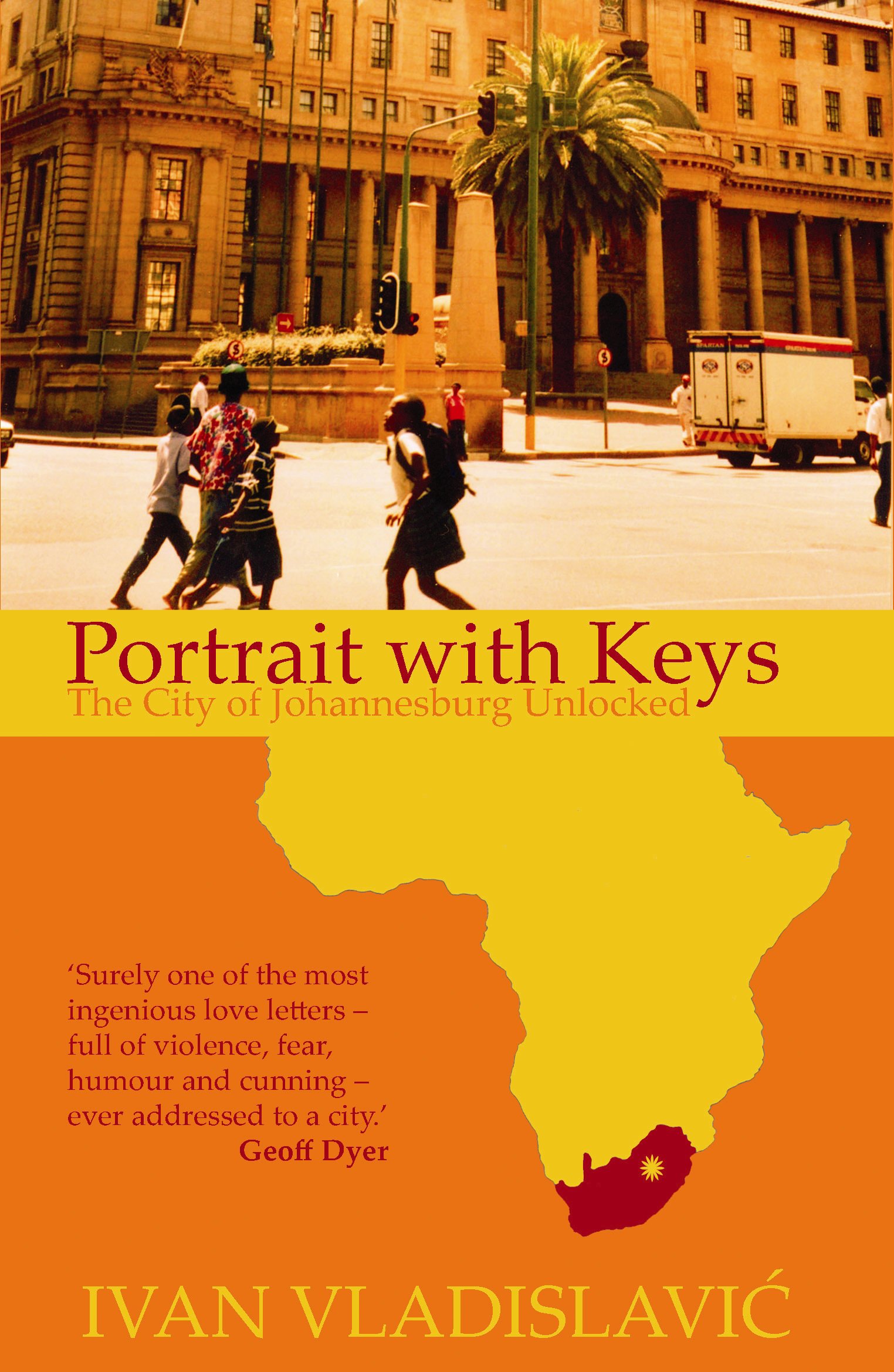
Ivan Vladislavić paints his Portrait with Keys: The City of Johannesburg Unlocked in a pointillist style, dividing up not quite 200 pages of main text into 138 anecdotes and observations, each of which shows some aspect of his life in the city in the late 1990s and early 2000s. The sections are numbered, enabling the structural innovation that Vladislavić alludes to in his title. After the main text and some brief notes, Vladislavić has added a list of itineraries through the book and, by implication, through the city. He explains, “This index traces the order of the previously published cycles [of anecdotes] and suggests some other thematic pathways through the book.” (195) Just as there are many routes to discovering a city, there are many ways through the book other than the author’s initial arrangement, and each one lends a different emphasis and tone to the book.
The itineraries come in different lengths, and none of them encompass the whole book, just as one afternoon’s walk cannot encompass one person’s experience of living in a city, let alone the full character of the place. Still, they’re interesting ways to consider what Vladislavić has shown of Johannesburg. The first one, “An accidental island,” lends its name to the German translation where I first encountered the book as part of the Süddeutsche Zeitung‘s metropolitan series. (The German title is Johannesburg. Insel aus Zufall and the edition I have lists the English title as Portrait with Keys: Joburg & what-what, which I think is more interesting than the current English title, but it’s probably less marketable.) Other itineraries include “Branko” (the author’s brother), the obvious “City centre” and “Memorials,” the more enigmatic “Object lessons” and “Trade secrets,” “Old lives” and the corresponding “Young lives,” and a couple dozen more.
These itineraries point out the essentially arbitrary order of Vladislavić’s anecdotes within the book, in presumed contrast with the care that an author generally takes in structuring a book, as a poet does in establishing a rhythm and dramatic progression within a collection, or indeed a novelist in arranging the events of the story. On the other hand, Vladislavić has taken care in how he has sequenced his anecdotes, as the points of color accumulate into a portrait of the city, shorter bits break up the slightly longer stories, and none of the other suggested itineraries run consecutively through the book. He has sacrificed an overall story for a collection of many incidents, and while it kept me at a distance from any one anecdote, it was a bit like the experience of getting to know a new city. Different things happen in different places, and it’s up to me to make overall sense of them.
The themes that came through most strongly in Portrait with Keys were crime and inequality. Vladislavić begins the book with an anecdote about house alarms.
There are no leisurely departures: there is no time for second thoughts, for taking a scarf from the hook behind the door, for checking that the answering machine is on, for a final look in the mirror on the way through the hallway. There are no savoured homecomings either: you do not unwind into such a house, kicking off your shoes, breathing the familiar air. Every departure is precipitate, every arrival a scraping-in. (p. 15)
The fear of crime shapes life inside even the sanctuary of home. Elsewhere in the book, Vladislavić describes how anti-crime measures have shaped the street he lives on. Fences have given way to walls; walls have given way to higher walls. In richer neighborhoods, the higher walls have acquired spikes and barbed wire on top. On his street, unmatched courses of brick in the walls show where gates used to be. When Vladislavić hosts a birthday party, he and his wife hire a security guard to watch over guests’ cars that they park on the street near his house. Theft of metal items for sale as scrap happens throughout the book: house numbers on the street, ornamental figures from the tips of older fences, public art even in central plazas. In one memorable anecdote, Vladislavić is walking down a street sees a salesman in a suit struggling with what must be a particularly heavy sample case. A few moments later, he sees that a manhole cover is missing, but by then the salesman is gone.
Beggars are a daily fixture, along with people who straddle the line between beggar and vendor. There is a person he sees regularly outside a business whose work consists of bringing a bathroom scale to that particular place and charging people 50 cents to tell their weight. People straddle the line between work and crime, too. When Vladislavić parks his car further into the city, he’s often approached by someone to pay to watch it; the implication of what might happen if he doesn’t pay is left unspoken.
The world of Vladislavić’s youth is passing. Part of that is middle age, part of that is the tremendous social change he is living through at the time the book is set. Several of his friends emigrate, and I got the sense that many more departures were left unmentioned. His brother tries to persuade him to move out to the suburbs. The bustling office tower with a massive shopping area underneath, where Vladislavić had his first job going from company to company trying to sell an office invention, has gradually emptied out so that where once you had to drive up to the fourth of fifth level of the parking garage to find a space, at the book’s beginning you can almost always find one on the ground floor and by its end the separate garage has closed entirely. The maternity hospital at the bottom of his street that Vladislavić remembers from his youth has gone through several incarnations, and at the end of Portrait with Keys it has been converted into an old folks’ home.
The political upheavals of Mandela-era South Africa take place largely off the page, although there may be allusions that people more versed in the history will catch. Only once does he describe getting caught up in larger events, when he goes to the library downtown, unaware that the square in front of it is to be the site of a rally by striking security company staff.
Before I can follow the thought there’s a loud bang, a shotgun report, I think, and the crowd bursts apart like shrapnel from the heart of a blast. Some of them rush away in an anti-clockwise whorl like water down a drain, others surge at me and carry me back toward President Street. I am running too, without thinking, and then stopping, as the wave subsides and wheels back intuitively towards the sound. We all turn, crouching, or huddled together, or craning boldly as if the whole range of attitudes has been choreographed. (p. 181)
Even there, the demonstration that turns into a small riot is just a thing that happens, another point of color in the overall picture of the city. Vladislavić’s approach gives a sense of the changing city, and his suggested itineraries point out how incomplete any single story about a metropolis will necessarily be. His studied distance kept me from feeling strongly about the place; it was interesting. I could see that he cared enough to live well within the city even as many of his peers departed, but I also felt the stand-offishness, as if interesting were as close as I was going to get.

 Al Singh
 Doug Merrill
 Doreen Sheridan
 Emily Lauer
 John Pitzel
 Lars N. Goldschlager
 Laura Eilers
 Professor X
 Robert Maedgen
 Sylvere Ap Leanan
 The Shire
1 ping
[…] half of the year, reflected that desire. I only finished five books of non-fiction all year, though Portrait with Keys mostly uses the techniques of fiction, so that number may be debatable. I only finished three books […]