I never did finish writing my review of Ancillary Mercy, the final book of Ann Leckie‘s Imperial Raadch trilogy, but here is part of its beginning:
Presger Translator Zeiat may be my favorite character in science fiction from 2015. I’ll have to think about it a little while more to be sure, but she is so vividly hilarious that off the top of my head, I’m having a tough time recalling a science fictional character who has brought me more delight. The characters around Zeiat, however, more likely find her unnerving because she could cause all of them to be destroyed without any great effort on her part; indeed, she might do it without even properly noticing that she had. A bit like a porcelain teacup full of nitroglycerin, being carried around by a rambunctious puppy.
In the universe that Ann Leckie has written about in Ancillary Mercy (and, of course, in its predecessors Ancillary Sword and Ancilary Justice), the Presger are immensely powerful aliens who caused great destruction in human space before that misunderstanding was cleared up by treaty, some 20 years before the action of the novels. The Translators mediate between the humans and the Presger; they look human, but they are clearly not, and their thought processes are unnervingly alien.
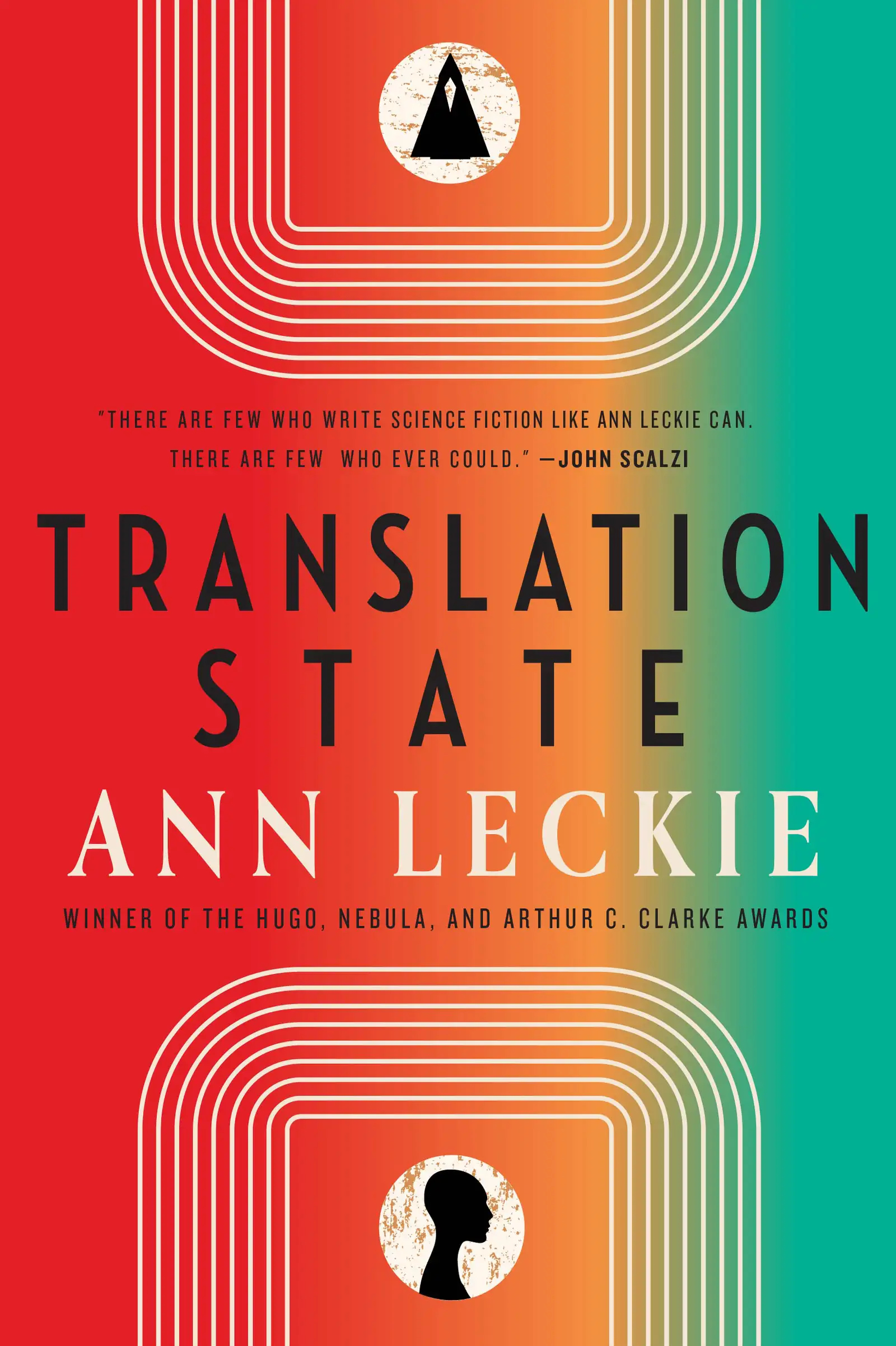
Not quite a decade later, Leckie returned to that universe with Translation State, although to a part of it far from the Raadch. (Her 2017 novel Provenance, which I have not read, is also set in the same universe.) While the title implies that the Translators will play a role, and the text on the book’s back cover confirms it, Leckie starts the novel from the point of view of a human named Enae. Sie uses sie/hir pronouns and has been caretaker to hir grandmother for many years. The grandmother was the fantastically wealthy matriarch of an old and prominent family; she was also both tyrannical and petty. The extended family pretended to revere her, in hopes of inheriting. She saw through it, of course, and surprised them all by cutting them out of the will. Even more surprising was that she had long since squandered the family fortune, and had been propped up in her later years by a rich parvenu, whom she had secretly adopted as heir. The arriviste got the house and the name, which she wanted; grandmother never had to let go of the style to which she had become accustomed; the extended family got to find out about the joke, which they somehow failed to find amusing.
Enae, however, did get something of a reward for having put up with her grandmother all those years. Sie was to be provided for, given enough money to live comfortably for life. The new heir, however, wants hir out of the way, well out of the way and persuades hir to take on a commission running down a diplomatic loose end that has been left hanging for the better part of two centuries. It’s meant to be a do-nothing sinecure; the job gives hir license to travel from system to system, live gracefully, see what she wants to see and have no particular cares. True to hir nature, Enae takes the commission seriously and finds that the trail is not as cold as everyone expected it to be, and that the fate of the lost person might be more important than assumed.
Leckie introduces a second point of view, distant in space from Enae, and even more distant in social standing. Reet is a young adult human of unknown parentage, adopted into a large foster family, now living on his own on Rurusk Station, and working as a lowly maintenance tech. He hasn’t bitten anyone hard since childhood, and he has kept his urges to take things, especially people, entirely to himself. Like many of his foster siblings, he has a hard time feeling like he belongs; unlike them, he has been unable to discover anything about his background. Even genetic research has not been helpful. It’s as if he descended from someone unknown to the records.
Qven is the third point of view, the only one who narrates in the first person. Non-human first-person. Qven shows readers what the world looks like to an incipient Presger Translator, a being made and brought up in a malleable, semi-organic place among a mass of others like Qven, progressing from Tiny to Little to Small. Qven takes up more detailed narration as a Middle, blandly recounting things that would unsettle most humans.
We found a way [to make weapons]. The first Middle I saw opened up was an unpopular, inoffensive creature whose only crime, I thought, was being weak. Now I suspect that their real crime was being not sufficiently zealously protected by those Adults who’d cared for us when we were Tinies and Littles and Smalls. You wouldn’t think that private disdain would communicate itself so clearly to us, oblivious as we were to any but our own fascinations and concerns, but I believe now that it can, and does.
It was shocking, and titillating, to see the layer of yellow fat under the skin, the liver gleaming smooth and wet beneath the ribs. One of us pushed the guts aside to reveal kidneys. But just as a few Middles began to explore ways to crack the sternum and reveal the frantically beating heart, the ground gaped and cilia pulled the screaming, sobbing Middle away.
They came back, after a while, and tried to hide from us, but we found them and removed a leg. … They were taken away again, and never returned. The leg was left behind, though, and that was amusing for a while.
They weren’t the only Middle that happened to. But of course it never happened to me. Not even the threat of it. I assumed—if I thought about it at all—that I was just better than those victims. That there had been something fundamentally consumable about them. (pp. 26–27)
Presger heedlessness and curiosity about things’ interior workings are more than a little horrifying when seen up close. The parallels to human societies’ actions are right there to see, too.
The three characters spiral towards each other in ways that I found easy to anticipate but nevertheless enjoyable. All three are contending with similar issues: Who are they? Where do they belong? What does belonging even mean? What can they count on, how far can they determine their own lives, and what do they want to do with those lives anyway? These are near-universal questions, but the particular circumstances of each of the three pose them in especially pointed form. Is Reet even human? There are powerful interests that would like to say no. Part of the tension of the novel is whether he can muster countervailing forces to keep even a small part of his fate in his own hands. Because Translation State is a standalone, I did not feel that any character’s happy ending, or even survival, was guaranteed.
Qven’s development reveals much that was unknown about the Presger, and here Leckie has to manage a tricky balance. Part of the thrill of their presence in the other novels was that they were hilariously bonkers, but they were also truly menacing. Writing more about them necessarily means making them more comprehensible. Once readers have looked through an incipient Translator’s eyes, will the Presger still be alien? Leckie goes a long way to resolving the dilemma by reminding that the Translators are themselves an in-between state. They are human enough to move and work among humans, if not actually to pass. The actual Presger are on the other side of that state of translation. Qven, the other Translators, the Teachers can communicate with them, can commune with them to some extent, but some things about the Presger still defy translation.
In science fiction, it was long presumed that the real and incontestable appearance of aliens on earth would unite humanity, especially if the aliens posed a threat. This view made its way into real international relations, most notably under President Reagan, who was in part motivated to negotiate with Gorbachev about nuclear weapons by his concern that nuclear war was a threat to all of humanity on a par with alien invasion. The world’s experience with covid-19 has shown that humanity will not unite in the face of a universal threat. Not only will reactions vary widely, some fraction of humanity will react by denying that there is a threat at all. In Translation State some people have come to believe that the Presger do not actually exist, and that therefore they cannot pose a threat to humanity, that the whole business with a treaty and Translators is just a pretext to keep power relations in place as they are. They’re as wrong as people who think ivermectin cures covid, but in Translation State this group has just enough resources to cause a disruption involving Emae, Reet and Qven, one that could bring about a demonstration of how very real and very destructive the Presger actually are. The later parts of the book are all about coping with this disruption, without also forgetting the personal questions facing the three protagonists.
These are just a few of the themes that Leckie considers while telling an adventure story of self-discovery with wide-ranging consequences. The questions of personhood are also important to other participants, such as representatives of the ships at the center of Leckie’s Ancillary trilogy. Reet’s parents travel to the site of the book’s final confrontations; their journey and Reet’s odyssey bring up questions about parenthood, families, and particularly about fostering. Emae’s pronouns, and the way that Qven’s gender is, iirc, never described keep gender and presentation in a reader’s mind throughout the book. There is a representative of the Raadch in the later chapters of Translation State who continues the usage of the Ancillary books by referring to all human characters as “she.” It’s a feature of Raadch language and seems to exasperate some of the other humans. None of these considerations slows down the story, but they are present for readers who appreciate ideas to chew on in an engrossing, multi-layered book that comes to a satisfying, if not entirely safe, conclusion.

 Al Singh
 Doug Merrill
 Doreen Sheridan
 Emily Lauer
 John Pitzel
 Lars N. Goldschlager
 Laura Eilers
 Professor X
 Robert Maedgen
 Sylvere Ap Leanan
 The Shire