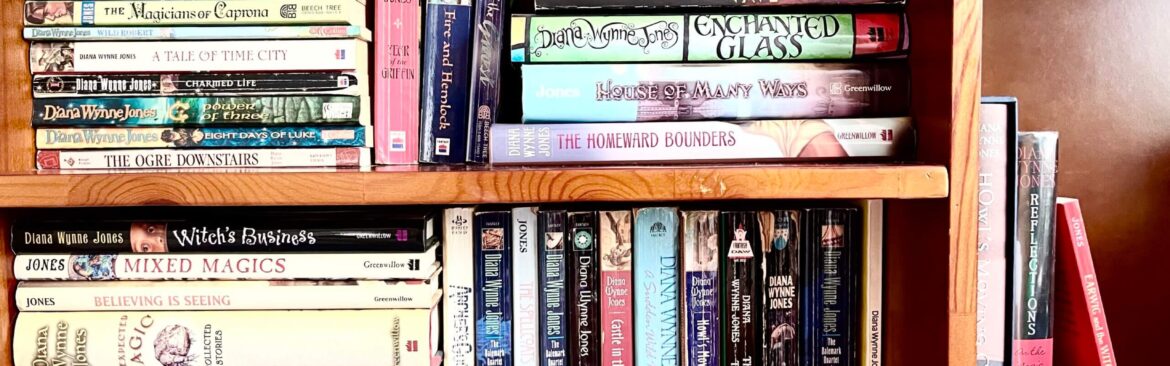
This post concludes my year of reading all of Diana Wynne Jones’s books! After her death in 2011, Earwig and the Witch was published the same year, and a collection of her nonfiction writing was published in 2012. Much more recently, Moondust Books has published collections of her plays and poems! In this post I’ll also be covering two outliers that I didn’t write about during the general readthrough: the very first published book by Diana Wynne Jones, Changeover (1970), which was her only non-speculative book for adults; and Yes, Dear (1992), her only picture book.
While I generally think of Diana Wynne Jones as a master of middle grades and YA fantasy novels, it’s lovely to get this wide perspective on the many other types of writing she did throughout her career.
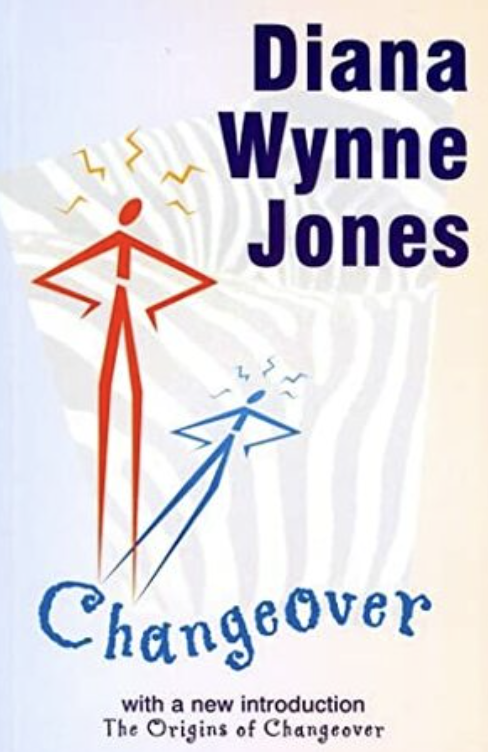 Changeover (1970)
Changeover was Diana Wynne Jones’s first published novel in 1970, and while it has no fantastical elements and is written for an adult readership, it already bears many of the hallmarks of her writing style that would come to characterize her books. When I think about Changeover in the context of Diana Wynne Jones’s work overall, it feels to me like a pilot for a show that underwent drastic changes before it got picked up.
Changeover is extremely out of print. I requested it through Interlibrary Loan and the loaning library stipulated that I could not take it home – I had to come read it on the library premises because physical copies of it are now so rare.
Changeover is a political farce, like a Jeeves and Wooster style plot in an internationally political setting. There are some extremely fun moments in a night club, but I personally did not find they were enough to carry the premise as far as they needed to go.
It takes place in a fictional African nation that is about to peacefully end British rule and begin independent rule. Plans for a celebration to “mark change-over” are misunderstood to be a warning about a dangerous British anarchist named Mark Changeover, who must be intending to sow mayhem (and perhaps bombs) at the event. A large cast of characters, both British and citizens of the fake African nation, are all ridiculed in turn for various levels of corruption, foolishness and hypocrisy.
I’m sorry this is blurry! Mea culpa. – Emily
Yes, Dear (1992)
Yes, Dear is a picture book illustrated by Graham Philpot, and like Changeover it is similarly difficult to get ahold of, and was not allowed to bring it home from the library. Since it is the only published picture book by Diana Wynne Jones, it is also an outlier.
In Yes, Dear, we follow a young child named Kay, who finds a magical golden leaf. Kay tries to engage each member of her family by sharing the wonderful magic of the leaf with them. The title of the book is the dismissive “yes, dear,” of her various family members who neither believe her nor take the time to genuinely interact with her either, as she and her magical golden leaf both go unappreciated. Finally, her granny pays attention and tells her that she, too, had a magical leaf as a child. They are satisfied with each other. It’s cute, and Philpot’s illustrations of the leaf’s magic fill the pages in a lush way that must have been engrossing for the original child readership of the book.
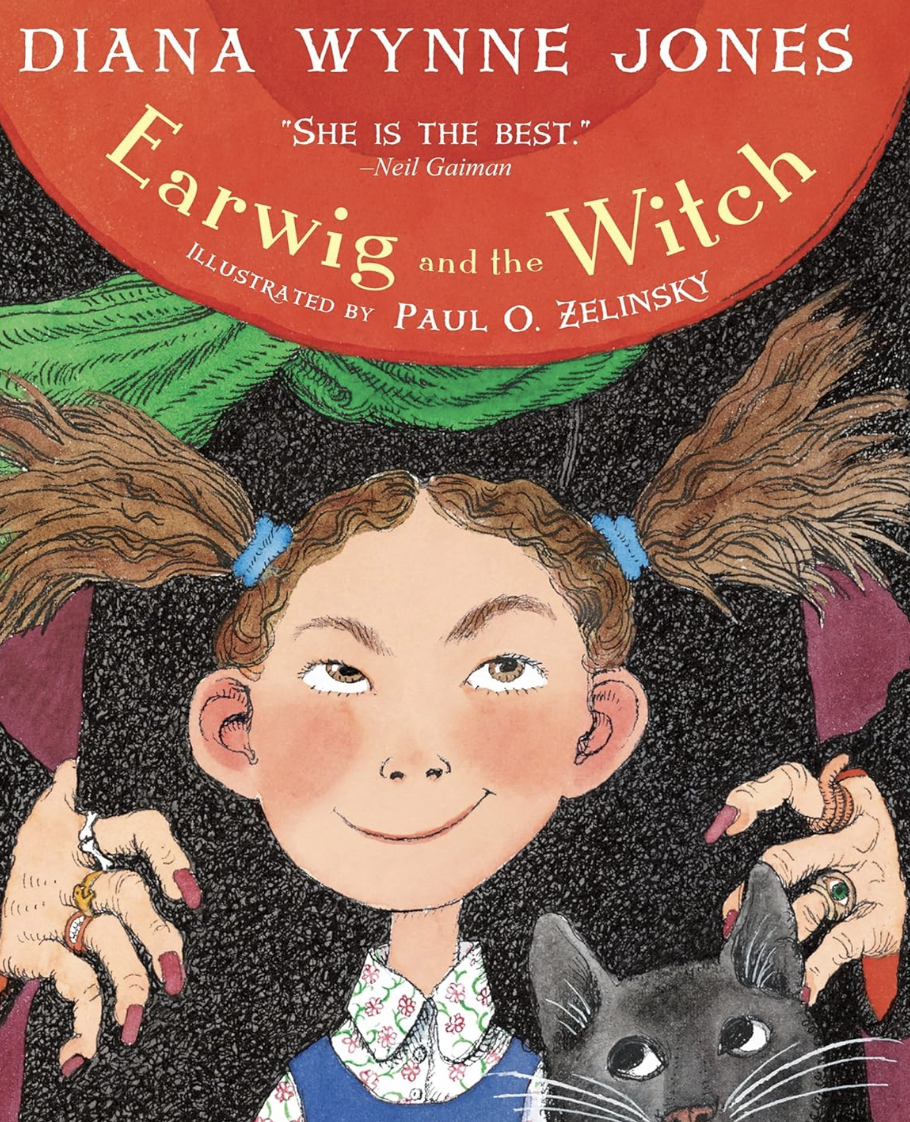 Earwig and the Witch (2011)
Earwig and the Witch is a short illustrated chapter book that feels like Diana Wynne Jones’s other illustrated chapter books for this age of reader: Wild Robert and Puss in Boots. Like those two, Earwig and the Witch is published as one standalone volume, but is far shorter (and bigger font size) than most of Diana Wynne Jones’s other work.
Earwig is a kid who gets taken into foster care by a witch who exploits her, and uses her own wiles to get what she wants out of the situation. It kind of reminds me of a “Clever Gretchen” story in that way, that this girl doesn’t get rescued by a prince or parent figure, but instead is rewarded for her own intelligence and initiative in molding a bad situation into one that works better for her. I think Earwig and the Witch is a nice coda to Diana Wynne Jones’s career.
Other fans have remarked that it feels like the outline of a Diana Wynne Jones book rather than a finished one, but to me it feels like it is geared toward much younger readers, who would find this book length, and the copious illustrations, rewarding. My edition was illustrated by Paul O. Zelinsky.
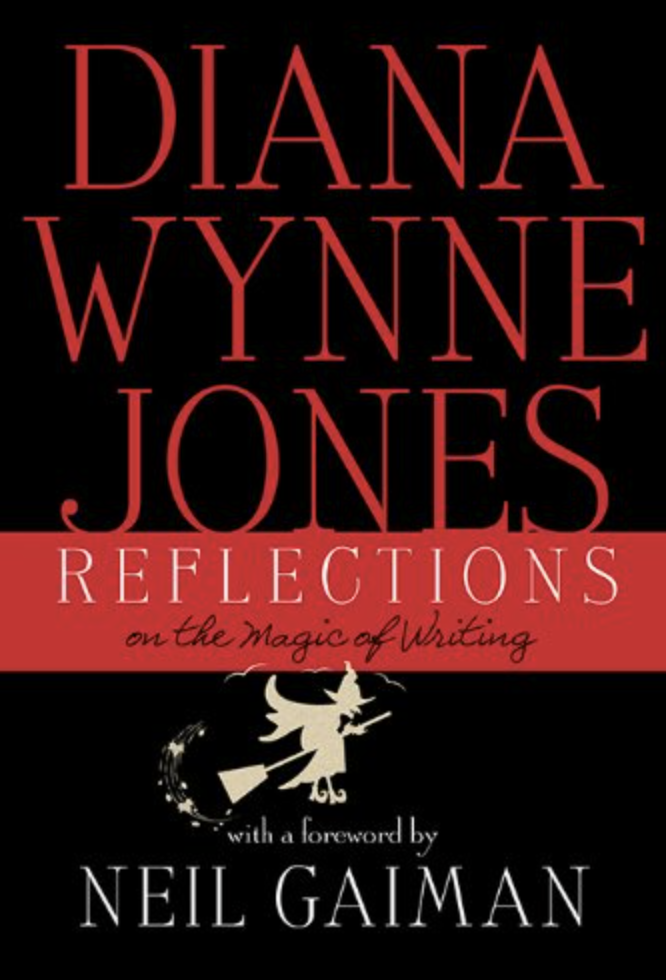 Reflections: On the Magic of Writing (2012)
Reflections: On the Magic of Writing collects a lot of Diana Wynne Jones’s nonfiction writing from throughout her career. It includes literary critiques of other fantasy authors’ work, autobiographical essays about her childhood and influences, advice to young writers, various invited speeches, and more. These various pieces were originally published or delivered from a lectern separately, and there is thus some skimmable overlap in material between them, but overall it provides a welcome wealth of context for her novels. For instance, it was illuminating for me to learn that the order in which she wrote books was not the order in which they were published.
One of my favorite parts was reading about what Diana Wynne Jones’s life was like while she was writing Changeover, and how the act of writing it was a refuge from chaos in her life at the time. The story itself was entertaining, I gained insight about Changeover and various ways this era of her life influenced her later work, and it also read an endorsement of creative, imaginative work as a healthy outlet in hard times.
 Poems (2019)
In 2019, Moondust Books published this collection of Diana Wynne Jones’s poetry, edited and with an introduction by her sister, Isobel Armstrong. The poems are grouped by subject matter, with sections like “Children,” “Myths” and “The Living World,” among others. I had definite favorites in each of the sections, which I think speaks more of my personal taste in poetry rather than the quality of the poems themselves. I tend to enjoy short, clear lyrical pieces with obvious rhyme schemes and regular rhythm. There are some of those in each section, and I appreciated them!
Armstrong discusses her selection and grouping of the poems in the Introduction, which I consider to be a highlight of this volume for its insights into how writing poetry fit into Diana Wynne Jones’s larger writing life. According to Armstrong, “most of her poems were written between novels, when the intensity of one kind of creative energy retreated and was replaced by another, often charged with the deep depression she experienced when a novel was completed.”
 Stage Magic: 4 Plays and a Screenplay (2024)
Stage Magic: 4 Plays and a Screenplay was published just last year by Moondust Books, edited and with an Introduction by by Meredith MacArdle. MacArdle tells us in the Introduction that “three of the plays were performed by the Unicorn Theatre for Children at the Arts Theatre in London: The Batterpool Business in 1967, followed by The King’s Things in 1969, and The Terrible Fisk Machine in 1970. The Princess in the Sea does not appear to have been performed in public, and […] The Fortune-Seller was written for BBC Children’s Television, but was not taken up by them.”
When I teach, I always tell my students that reading playscripts is like cheating: these are meant to be working documents to create three dimensional live performances in real time, not things meant to be silently read solo on a page. While I would absolutely love to see any of these staged, I did cheatingly find them a very good reading experience, full of life and quick-moving clear action.
My favorite was The Terrible Fisk Machine, in which a despicable toymaker and an odious inventor team up to shrink people and sell them in glass bottles as novelities. Some of the shrunken people team up with a mouse to rescue the rest, and there is a lot of villain moustache-twirling and fun playing with scale that would be wonderful to see onstage.
—
Thank you for joining me on this year-long journey! After reading all of Diana Wynne Jones’s books in a row, I definitely feel like I have a better sense of her overall trajectory as an author, and a better appreciation for the way she would return to and refine themes throughout her career.
After A Year on Discworld and now A Year of Diana Wynne Jones, it will be tough to think of another fantasy author who will be equally rewarding and enjoyable to read weekly in this way!

 Al Singh
 Doug Merrill
 Doreen Sheridan
 Emily Lauer
 John Pitzel
 Lars N. Goldschlager
 Laura Eilers
 Professor X
 Robert Maedgen
 Sylvere Ap Leanan
 The Shire
1 comment
Thanks for bringing these to Frumious! I have really enjoyed reading them.