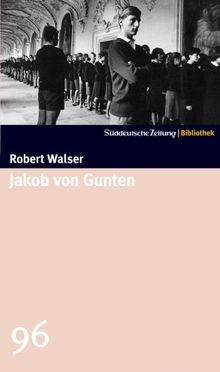
Well I suppose that Jakob von Gunten is a bildungsroman because it follows its young and eponymous first-person narrator through his later school years and ends with his departure from the Institut Benjamenta. On the other hand, its 144 pages raise some doubts about whether it qualifies as a Roman, although the Süddeutsche Zeitung published it in the newspaper’s second set of great novels of the 20th century. I’m also not sure how much Bildung goes on. While most of the novel takes place inside the Benjamenta, I think it shows even less of classes and lessons than The Confusions of Young Törless, and that was precious little. Jakob’s progress shows mainly in his interactions with the school’s namesake director. It is a peculiar book, which is fair, because Walser led a peculiar life.
The novel is set more or less at the time of writing, which is to say 1909. Walser turned 31 that year. He had led a peripatetic life as a young man, leaving Biel, Switzerland where he grew up for Stuttgart, where he had a brother, and then later moving on to Zurich, where he worked irregularly in various office jobs. Following Zurich, he lived in Thun, Solothurn and Winterthur (all Swiss) and Munich; he did his mandatory military service, and then in 1905 he moved to Berlin, to which his brother had in the meantime moved. Walser had been publishing stories in various magazines, and in 1904 he published his first book, a collection of essays. This was a time when it was possible to make a living — sometimes modest, sometimes precarious, for a fortunate few quite tidy — writing for the numerous newspapers and periodicals in the big German-speaking cities. At its more esoteric end, this milieu shaded into the settings described in Herr Dame’s Notebooks; at its more carefree, the kinds of light adventures described in Castle Gripsholm by Kurt Tucholsky, who is counted as an admirer of Walser. In 1905 Walser attended a course to become a servant at an aristocratic castle. The years just after the turn of the 20th century were still a time when European nobility continued to openly wield power from castles large and small, and training such as Walser had could lead to an actual job. The school shared characteristics with the fictional Benjamenta, but Walser as a 27-year-old trainee would have been very different from teenaged Jakob von Gunten.
Walser relates incidents from Jakob’s time at the Benjamenta in short, first-person section. While they sometimes report things that people to say, or even repeat conversations, functionally they are all monologues, thoughts that occur to Jakob which he then sets down on paper. They are chronologically arranged, but there is not a great deal of continuity between them, and there is only the barest of overarching narrative. There are also contradictions, or perhaps more charitably, examples of Jakob’s growth and changing perceptions. For example, early on he tells how he would disdain his older, more prosperous brother if he saw him on the streets of the small city where the Benjamenta is located, how he would at most speak formally if spoken to, but would on no account socialize with him or try to cultivate a closer relationship. Yet when he does later encounter his brother on the street, they go for a meal and beers, and have a convivial conversation. The brother invites Jakob to his home, and he eventually becomes something of a regular at his brother’s soirees, with the slightly older crowd marveling at his manners and seemingly happy to have another von Gunten as part of their circle.
Jakob’s relations with the other characters, only three of whom are given much detail, are similarly full of contradictions. His fellow pupil Kraus is something of a grind. Lacking Jakob’s memory and actually caring about the assignments, Kraus is usually seen studying, bashing things into his mind by sheer grit and repetition. He’s also grumpy most of the time. Jakob veers between annoyance and admiration. “Someone who could be cross, ach, I find a person like that sympathetic. Kraus was cross on every occasion. That is so beautiful, so humorous, so noble. And we complement each other so well. The outraged and the sinner always have to be opposite each other; otherwise something is missing.” (p. 26, my translation) Fräulein Benjamenta, the school director’s sister, and the only teacher that Walser actually shows, is at once a vision of the unattainable feminine, a disciplinarian verging on a dominatrix, and a slightly lost woman, tied to her brother’s sketchy school with little in the way of other prospects, or indeed any apparent life outside the school. Late in the book, she tells Jakob that she is dying, confesses that she sees him as more special than any of the other students, implores her to kiss her just once, chastely.
Herr Benjamenta is Jakob’s main counterpart throughout the book. He is a volatile character, sometimes violent with his charges, sometimes cajoling them, sometimes displaying considerable if distant affection. Early on in his time at the Benjamenta, Jakob enjoys trying to provoke the director, bursting into his office and making demands, or writing assignments in a manner that is deliberately arrogant and inappropriate. As the book continues, the roles seem to reverse, with Herr Benjamenta hoping for a reaction from Jakob. He veers from the distant and mighty director to someone who appears to want the approval of this one particular pupil. From the perspective of 2026, it is all kinds of inappropriate, even compared with how schooling is depicted in other works of roughly the same period. On the other hand, Jakob was never a reliable narrator — he certainly does not read like a pupil in his teens — and so the question arises of whether Walser intended the book’s events to be treated as realistic in any fashion. On the other other hand, the highs and lows of adolescence, the grandiosity and the baseness that run so close together, is psychologically accurate, and it is this interior monologue that other writer have praised in Walser’s work. Certainly the book’s final episodes — Fräulein Benjamenta’s prophecy of her impending death, the closure of the school as all of the pupils save Jakob depart for work in the outside world, Jakob’s decision to travel the world with Herr Benjamenta — read more as fable than anything else. Like a teen’s imaginings, it is all heightened and disjointed.
At several points in the book, Jakob either mentions people saying how low standards had fallen in the modern era, or thinks himself how much worse the world and Europe have gotten in recent years. This is of course the era that has gone down in history as the Belle Epoque, a civilized age that combined material and scientific progress with peace in Europe. Or at least in the parts of Europe that count. Crowned heads ruled as well as reigned; the tumult of revolutions was a memory from long ago; people, so the story goes, knew their place and were content to stay there. That’s how it seemed to people who looked back on the era before the Great War, anyway. That would be news to Jakob and his cohort, who said that things had been better in their forbears’ times, though perhaps they would be among the lucky ones who survived the war unscathed and could look back at that lost era.
Walser himself made it through several more eras. His literary fame and fortune remained modest. He experimented with different forms, and his writing became more abstract, although it continued to find admirers. Mental illness seems to have run in his family: his mother is described in Wikipedia as having been emotionally disturbed; one brother died in an asylum, another committed suicide. In 1929 he had a breakdown — anxieties and hallucinations, among other symptoms — and went to the Waldau psychiatric home in Bern. He lived in institutions, sometimes writing, sometimes in better balance, other times not, for the rest of his life. He died of a heart attack while on a forest walk in 1956.
+++
Jakob von Gunten was translated into English by Christopher Middleton and published by the University of Texas Press in 1970; the novel was republished by New York Review Books Classics in 1999.

 Al Singh
 Doug Merrill
 Doreen Sheridan
 Emily Lauer
 John Pitzel
 Lars N. Goldschlager
 Laura Eilers
 Professor X
 Robert Maedgen
 Sylvere Ap Leanan
 The Shire
1 ping
[…] “Ich” (“I”) 95. Penelope Fitzgerald: The Blue Flower 96. Robert Walser: Jakob von Gunten 97. Ingeborg Bachmann: Malina 98. Arno Schmidt: Das steinerne Herz (The Stony Heart) 99. Leo […]